






by Maximiliano Crocamo
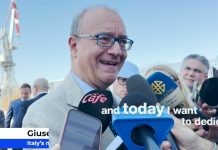
Italy’s political divisions briefly took a back seat on Wednesday evening as Carlo Calenda, leader of the centrist Azione party, shared the stage with Friuli Venezia Giulia Governor Massimiliano Fedriga for a wide-ranging discussion on Europe’s future, democracy and the challenges facing the West.
The event, held at Trieste’s Teatro Verdi, marked the presentation of Calenda’s new book, Difendere la libertà. L’ora dell’Europa (“Defending Freedom: Europe’s Hour”). Moderated by journalist Francesco De Filippo, the conversation explored geopolitical tensions, European governance and the increasingly fragile state of liberal democracy.
Calenda argued that Europe remains “the best place in the world to live,” but warned that it faces mounting pressure from three global powers with competing interests. China, he said, seeks European markets for its exports; Russia aims to restore its imperial influence; and the United States, particularly under President Donald Trump, has pushed Europe to weaken regulations governing digital platforms and data privacy.
The Azione leader painted a sobering picture of democracy’s global retreat, noting that fewer than 20 percent of the world’s population now lives in a liberal democracy, compared with roughly 40 percent in 2012. To respond to growing security threats, he proposed a €1 trillion European Union common debt initiative, with part of the funding dedicated to creating a shared missile and drone defense system along the bloc’s eastern border.
Despite representing opposing political camps, Calenda spoke warmly of Fedriga, describing the governor as “a pragmatic moderate” whom he respects. He said Italian politics still contains reasonable figures on both the center-left and center-right who are willing to engage in constructive dialogue.
That spirit of civility was tested when the discussion turned to persistent speculation that Fedriga could run for mayor of Trieste. Calenda declined to offer unconditional support, saying any backing would depend on political ideas rather than personal relationships. Fedriga, meanwhile, once again avoided answering directly whether he intends to enter the race.
Calenda also reaffirmed that Azione would not form alliances with political forces connected to MEP Roberto Vannacci, drawing a clear boundary around his party’s future electoral strategy.
Fedriga used the occasion to articulate his own vision for Europe’s future, emphasizing that Western democracies must remain united regardless of shifting political leadership.
“The democracies of the West are the systems that best guarantee both freedom and prosperity,” he said, arguing that authoritarian governments may appear efficient but ultimately demand unacceptable sacrifices in individual liberties.
Recalling conversations with business leaders who praised China’s administrative efficiency, Fedriga said he often asks whether Europeans would truly be willing to exchange their freedoms for that model. He pointed to China’s extensive surveillance of its citizens as evidence of the price paid for centralized control.
The governor also criticized the European Union’s institutional structure, arguing that its decision-making process too often produces the lowest common denominator rather than decisive action.
Drawing a comparison with Friuli Venezia Giulia’s former intermunicipal governance system, known as the UTI, which was abolished during his administration, Fedriga argued that institutions function best when leaders are directly accountable to voters rather than to competing member governments.
“European governance must have an incentive to answer to all European citizens,” he said. “Only then can it achieve real synthesis instead of endless negotiation.”
Although Calenda and Fedriga differ on many domestic political issues, the evening revealed notable areas of agreement on Europe’s strategic challenges. Both warned against complacency in the face of rising geopolitical competition and argued that defending democratic institutions requires stronger European cooperation, even if they envision different paths toward achieving it.
The discussion unfolded without the partisan confrontations that often dominate Italian political debate, offering instead a rare example of ideological opponents engaging in a substantive conversation about Europe’s future at a moment of growing international uncertainty.