


















by InTrieste
Officials in the Friuli Venezia Giulia region are expanding efforts to strengthen local commerce through a growing network of retail districts, backed by public funding, training initiatives and closer coordination among business leaders.
Speaking at a meeting with district managers in Udine on Tuesday, Sergio Emidio Bini, the regional councillor for productive activities, emphasized the importance of simplifying administrative processes while increasing resources aimed at supporting businesses. He described district managers as key intermediaries responsible for translating regional strategies into tangible economic outcomes.
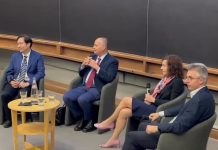
The gathering brought together managers from across the region to assess progress and share best practices. Opening remarks were delivered by Alberto Bramanti of Bocconi University, who noted that Friuli Venezia Giulia’s approach stands out within Italy for its emphasis on collaboration and structured knowledge-sharing. Central to that model is what officials describe as a “community of practice,” designed to foster ongoing dialogue and coordination among district leaders.
Regional authorities view this collaborative framework as essential to the next phase of development. By encouraging managers to work across sectors rather than in isolation, officials hope to strengthen long-term planning and improve the ability to measure outcomes over time.
The retail district system has expanded significantly over the past two years. Between 2024 and 2025, it has grown to include 135 municipalities, engaging 110 primary partners and a total of 245 public and private stakeholders. Officials say the initiative has broadened both its geographic reach and its capacity to involve local actors.
Public investment has followed a similar trajectory. The region has allocated more than €12 million to the districts across multiple funding cycles. Initial support in 2023 amounted to €9 million to launch the first 20 districts. Subsequent allocations included €1.1 million in 2024—split between strengthening existing projects and creating two new districts—and €2.6 million in 2025, supporting both consolidation and the establishment of three additional districts.
A significant portion of the program has focused on digital transformation. District-led funding calls have reached 126 municipalities, covering roughly 93 percent of the region. To date, €2.5 million has been distributed to 688 beneficiaries, generating total investments of more than €4.4 million. The average contribution per project stands at just over €3,700, complementing other regional funding tools aimed at small retailers and production investments.
Beyond financial support, the initiative has also prioritized training. Districts have organized programs in financial literacy, marketing, digital tools and artificial intelligence, reflecting broader changes in the retail sector. Officials say these efforts are critical as businesses adapt to shifting consumer behavior and technological demands.
Looking ahead, regional authorities are developing a primary plan to map commercial activity across Friuli Venezia Giulia. The goal is to identify areas of decline—both in smaller municipalities and within urban centers—and to guide future policy decisions with more detailed data and analytical tools.
The system’s momentum is also reflected in its replication. Eleven districts have already launched multiple annual funding rounds, while several municipalities have independently introduced similar initiatives, often inspired by district-level strategies.