


















by Maximiliano Crocamo
Interviewees: Fabio Scoccimarro, Councilor for Environmental Protection, Energy, and Sustainable Development; Renato Colucci, Senior Research Scientist at the Institute of Polar Sciences (ISP-CNR), Italian National Research Council. Lecturer of glaciology Department of Mathematics, Informatics and Geosciences at the University of Trieste; Fulvio Stel, Scientific and Technical Director Arpa FVG
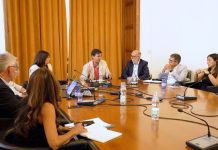
The Regional Agency for Environmental Protection of Friuli Venezia Giulia (Arpa FVG) presented the second 2026 edition of Terra Rara on Monday, launching its quarterly digital magazine alongside the fourth edition of Segnali del Clima FVG 2026, the agency’s annual scientific report on climate trends in the region.
The publication offers a broad overview of environmental conditions across Friuli Venezia Giulia through scientific data, analysis and multimedia storytelling, with this summer edition placing particular emphasis on the region’s marine environment, coastal monitoring and seasonal environmental indicators.
Opening the issue is an editorial by Regional Councilor for Environmental Protection Fabio Scoccimarro, who reflects on the environmental challenges facing the region during the summer months. The magazine then turns its attention to the Adriatic Sea, featuring an interview with Claudia Orlandi, head of Arpa FVG’s Marine Waters and Transition sector, on the growing impact of underwater noise pollution, the effects of human activity on marine ecosystems and the launch of a new citizen science application designed to involve the public in coastal monitoring.
The publication also includes a podcast and infographic examining the changing Gulf of Trieste, documenting rising sea temperatures, shifts in marine biodiversity and the increasing presence of invasive species. Additional features analyze how hailstorm patterns have evolved across Friuli Venezia Giulia, explain key summer environmental indicators—including ozone concentrations, ultraviolet radiation, bioclimatic stress and water balance—and conclude with Micro, an educational video following three discarded pieces of litter from mountain streams to the sea to illustrate the environmental consequences of waste dispersion.
Presented alongside the magazine was Segnali del Clima FVG 2026, a collaborative report bringing together contributions from researchers and institutions working on climate science, environmental monitoring, mitigation strategies and climate adaptation across the region.
Climate debate emerges during presentation
The event took an unexpected turn when Scoccimarro, expanding on themes raised in his editorial, stated that the Earth’s climate follows approximately 500-year cycles and suggested the planet is moving toward a new glacial phase. He cited this interpretation while discussing the importance of investments aimed at strengthening the resilience of Friuli Venezia Giulia’s coastline.
His remarks prompted an immediate response from Renato Colucci, senior researcher at the National Research Council’s Institute of Polar Sciences (CNR), lecturer in glaciology at the University of Trieste and one of the contributors to Segnali del Clima FVG 2026.
“The objective data tells us that the current warming does not have natural origins,” Colucci said during the presentation. While acknowledging that natural climate cycles are well established in the scientific literature, he argued that the influence of human activity has overwhelmingly surpassed natural variability during the past century and a half. He added that he could not “be complicit” in statements he considered inconsistent with current scientific evidence.
Speaking to reporters after the event, Scoccimarro said he was surprised by the exchange, maintaining that both he and Colucci agreed that human activity has contributed to environmental degradation. While he did not repeat his earlier reference to a 500-year climate cycle or an approaching glacial phase, he also did not withdraw the statement. Colucci, for his part, maintained his position.
The exchange underscored the differing interpretations that can arise even during the presentation of scientific publications, while leaving the focus on the extensive body of environmental monitoring and climate data collected by Arpa FVG and its scientific partners.
The full edition of Terra Rara and the complete Segnali del Clima FVG 2026 report are available on Arpa FVG’s official website.