













by Nina Vaclavikova
Interviews: Paolo Sardos Albertini, President of the Lega Nazionale; Serena Tonel, Deputy Mayor of Trieste
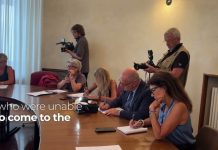
City officials on Thursday unveiled a commemorative plaque beneath the arcades of City Hall in Piazza Unità d’Italia, marking the 80th anniversary of an anti-Nazi uprising that took place in the square during the final days of World War II.
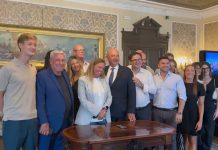
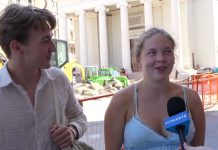
The plaque recalls the events of April 30, 1945, when local resistance forces in Trieste rose against German occupation as the war in northern Italy approached its end. The ceremony was attended by the deputy mayor, Serena Tonel, along with municipal officials and representatives of civic organizations.
The inscription honors the order of insurrection issued by Edoardo Marzari, head of the city’s National Liberation Committee, and the role of resistance commander Antonio Fonda Savio. It notes that the Italian tricolor displayed on City Hall became the target of enemy fire during the fighting.
The unveiling comes as Trieste marks eight decades since the confrontation that unfolded in the square and surrounding buildings, including City Hall and the nearby Government Palace.
In remarks at the ceremony, Tonel described the plaque as part of an effort to acknowledge a complex chapter of the city’s 20th-century history and to contribute to a shared understanding of the past. Recognizing historical events, she said, can help strengthen civic memory and social reconciliation.
The ceremony also included comments by Paolo Sardos Albertini, president of the Lega Nazionale, who emphasized the significance of April 30, 1945, as a moment when local forces sought to assert the city’s identity during the final phase of the war.
In late April 1945, while German garrisons across northern Italy resisted the advance of Allied troops and partisan formations, the situation in the region of Venezia Giulia remained tense. German forces sought to maintain control of the area to preserve a route of retreat toward the north.
According to historical accounts, Marzari ordered the uprising with the support of roughly 2,000 volunteers organized in resistance groups such as the “Domenico Rossetti” and “Giustizia e Libertà” formations. Many of the fighters were members of the city’s Civic Guard.
At dawn on April 30, volunteers from the Pisoni brigade occupied the Government Palace, while the Civic Guard secured City Hall, where the city’s podestà, Cesare Pagnini, was present. Fighting continued into the following day.
On May 1, as Yugoslav forces approached the city, Marzari ordered the Italian flag raised on both the Government Palace and City Hall. German naval units stationed along the waterfront responded with gunfire aimed at the buildings and the flags displayed on them. Resistance fighters returned fire, and the confrontation escalated around the square.
The exchange was partly driven by efforts to prevent German engineers from detonating explosives reportedly placed near the waterfront and port infrastructure, which could have caused severe damage to the city.
Today, the façade and columns of City Hall still bear marks from the gunfire of those clashes. The new plaque, installed under a municipal resolution adopted earlier this year, was placed to commemorate the events and the individuals involved in the uprising that took place in the square during the final days of the war.