




















by Nina Vaclavikova
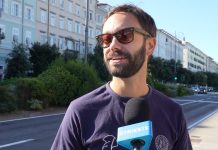
Interviews Caterina de Gavardo, Trieste City Councilor for Urban Security Policies; Paolo Jerman, Deputy Commander, Trieste Local Police
A year after launching round-the-clock patrols, Polizia Locale di Trieste says the expanded service has transformed the way the city monitors its streets, responds to emergencies and confronts urban decay.
Speaking at City Hall on Tuesday, city security councilor Caterina de Gavardo and deputy police commander Paolo Jerman described a force that now operates continuously from 7 a.m. to 7 a.m., with coordinated six-hour shifts designed to guarantee a constant presence across the city.
The changes, introduced in May 2025, go well beyond parking enforcement — long the stereotype associated with local police in Italy. Officers now handle traffic control, accident investigations, anti-degradation patrols, commercial and construction inspections, and specialized units targeting document fraud, domestic violence and stalking.
During daytime hours, the force deploys roughly 20 patrols simultaneously. Seven morning patrols and six afternoon patrols focus on traffic safety and emergency response, while dedicated proximity-policing and special intervention units patrol neighborhoods on foot, monitor abandoned vehicles and bicycles, and work alongside the Questura on anti-degradation operations. In 2026 alone, the city has already carried out 36 joint operations with state police authorities.
Officials also highlighted the growing role of community policing. Through the “Rioni Sicuri” initiative, officers use a mobile station to meet residents directly in central neighborhoods, peripheral districts and public parks. The unit is supported by Conan, the department’s canine officer, now fully integrated into daily operations.
Night coverage — once limited — has become a key feature of the overhaul. Two patrols operate from 6 p.m. to midnight and another two from midnight to 6 a.m., focusing primarily on emergency interventions and traffic accidents. According to the department, local police now investigate more than 90 percent of all road accidents within city limits.
Updated figures released Tuesday show that between May 2025 and May 2026, officers recorded 728 traffic accidents, including 278 involving injuries and 450 causing only material damage. No fatal accidents were recorded in 2026.
Mr. Jerman acknowledged that the transition to a 24-hour model required a “profound reorganization” of the force, including constant adjustments and monitoring. But he said the system has proved effective in strengthening public safety and ensuring faster emergency response across the city.