
















by Nina Vaclavikova
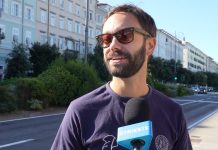
Interviews: Caterina De Gavardo, Councillor for Urban Security Policies; Paolo Jerman, Deputy Commander of the Local Police
Seeking to strengthen ties between residents and local authorities, the city’s municipal police are expanding a community-focused initiative that brings officers directly into neighborhoods — and, for the first time, into public parks and gardens during the busy spring months.
The program, known as “Rioni Sicuri” (Safe Neighborhoods), was introduced in 2025 as part of a broader effort to make policing more visible, accessible and responsive. Managed by the city’s proximity policing unit, the initiative centers on a mobile office that travels through different districts, offering residents an opportunity to voice concerns, report issues and engage informally with officers.
This year’s expansion reflects a shift toward spaces where residents increasingly gather as the weather warms. Parks and gardens, particularly popular with families and children, will now serve as additional points of contact between citizens and law enforcement.
City officials say the goal is not only to improve public safety but also to foster a sense of trust and familiarity. By emphasizing listening and informal interaction, the initiative aims to make institutions feel closer to everyday life.
The pilot phases of the program, conducted in two periods in 2025 — late spring and early autumn — were met with positive feedback. Over several months, officers visited 13 neighborhoods and 17 locations, dedicating roughly 300 hours of fieldwork and collecting about 100 citizen reports. Officials say the feedback has helped shape the program’s current iteration.
Under the 2026 plan, the initiative will operate in two-week cycles. In each cycle, officers will focus on two neighborhoods and one park, alternating between a fixed mobile station — where residents can approach them directly — and foot patrols through nearby public spaces.
The first phase begins at Passeggio Sant’Andrea, with officers initially stationed near their vehicle before moving into surrounding parks to engage with the public. Future stops will include districts such as Roiano and San Giacomo, with regular updates shared through the municipality’s social media channels.
Local police officials describe the program as a form of “participatory security,” aimed at prevention as much as enforcement. Officers on foot patrol are tasked not only with responding to citizen concerns but also with identifying early signs of urban neglect, such as abandoned vehicles or improper waste disposal, before they escalate into larger problems.
The proximity policing unit, which has grown in recent years, is seen as a key component of this strategy. Its officers are trained to operate in a more conversational and approachable manner, a style that officials say encourages residents to speak more openly.