



















by Nina Vaclavikova
Interview: Caterina de Gavardo, Trieste’s city councilor for public safety; Walter Milocchi, the municipal police commander
Police recorded 13 crashes involving wild animals through Sept. 24, more than twice the total in either of the previous two years. Officials also outlined rules governing pets in public spaces.
Collisions involving wild animals have increased on roads around Trieste, prompting local officials to urge motorists to slow down, particularly at night, and to remind residents of regulations governing the treatment of domestic animals.
The city’s municipal police recorded 13 accidents involving wildlife, including roe deer and wild boars, between Jan. 1 and Sept. 24, 2026. That was more than twice the number recorded in either 2024, when there were five, or 2025, when there were six. The total for the three-year period was 24.
The most affected areas include the Karst plateau and roads bordering wooded sections of the city, among them Viale al Cacciatore and Via Marchesetti, near Farneto Park.
Caterina de Gavardo, Trieste’s city councilor for public safety, said the increase warranted greater caution, especially after dark. She also noted that regional animal-welfare legislation requires motorists in Friuli Venezia Giulia to stop and provide assistance after collisions involving wildlife, extending obligations that apply nationally to domestic animals.
Drivers who fail to assist an animal after a collision can face fines ranging from 421 to 1,691 euros if they caused the accident, or from 85 to 337 euros if they were not responsible for it, according to the municipal police.
Authorities advise motorists involved in a collision to stop in a safe location, activate hazard lights, place a warning triangle and alert approaching traffic. Drivers should not approach or touch an injured or dead animal, and should call the emergency number 112 or Trieste’s municipal police operations center at 040.366.111, which operates around the clock.
The regional government also provides a procedure for seeking compensation for certain vehicle damage caused by wildlife.
The police briefing, held at City Hall by Ms. de Gavardo and Walter Milocchi, the municipal police commander, also addressed regulations for the city’s large population of companion animals.
About 23,500 dogs are registered in Trieste, or roughly one for every eight residents. Between May 2025 and April 2026, municipal police issued 60 citations for violations of animal-related rules.
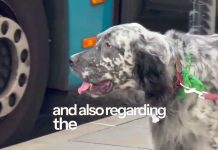
Dogs must be kept on leashes in public spaces. Owners are required to carry a muzzle and use it when an animal poses a risk or when authorities request it. Both leash and muzzle are required in public establishments and on buses, where only one dog is permitted at a time. Violations carry a 50-euro fine.
Owners must also clean up after their dogs, with a 200-euro penalty for failing to do so. The city prohibits dogs from urinating on vehicle tires, building entrances and shop windows, a violation punishable by a 100-euro fine.
The briefing also emphasized owners’ responsibility for preventing animals from injuring people or other animals. In cars, passengers transporting more than one pet must use suitable carriers or a separating barrier. A single animal may travel in the front seat if properly secured and not posing a danger to the driver. Towing an animal by bicycle is prohibited.
Police cited recent cases involving animal welfare, including the reported transportation of a small dog inside a scooter’s under-seat compartment and the rescue of a dog left in a car during summer heat. Both cases prompted action over suspected mistreatment or improper confinement.
Ms. de Gavardo said the city’s proximity to wildlife and its substantial population of companion animals made responsible behavior essential to public safety and the well-being of animals.