














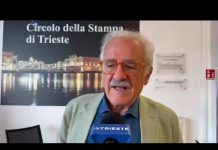

interview: Nina Vaclavikova
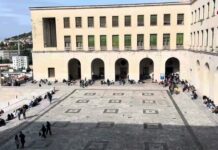
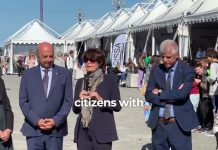
Italian Foreign Minister Antonio Tajani called for accelerating the European Union’s enlargement into the Western Balkans, reaffirmed Italy’s support for Ukraine, and defended stronger border security during a wide-ranging appearance at the Annual Forum of the South-East Europe Observatory in Trieste on Tuesday, 15 September.
Addressing an audience that included hundreds of students, Tajani described Europe as central to Italy’s future, calling the European Union a source of security, shared identity and economic prosperity.
“Europe represents our future,” he said, arguing that bringing younger generations into discussions about European integration is essential.
Western Balkans remain Italy’s priority
Tajani said Italy is working alongside Slovenia and Croatia to speed up accession talks for Western Balkan countries, with Montenegro identified as the most advanced candidate.
He also highlighted Trieste’s strategic position as the future northern terminal of the India–Middle East–Europe Economic Corridor (IMEC), saying the city could strengthen its role as a gateway linking the Mediterranean with Central and Eastern Europe.
Ukraine, he added, remains on a separate but parallel path toward membership.
“We will help Ukraine meet all the necessary criteria so it can join the European Union at the appropriate time,” he said.
Support for Ukraine, but not surrender
The foreign minister reiterated Italy’s commitment to providing political, economic and military assistance to Ukraine while emphasizing that Italy is not directly at war with Russia.
He said Rome continues to support initiatives aimed at achieving peace, but rejected the idea that peace should come through Ukrainian capitulation.
“Peace is one thing; surrender is another,” Tajani said.
On a new military assistance package requested by Kyiv, including defensive systems, he said the measure has already been authorized by Parliament and will soon be presented confidentially to Italy’s parliamentary intelligence oversight committee by Defense Minister Guido Crosetto.
Energy independence over dependence on Russian gas
Responding to comments by Deputy Prime Minister Matteo Salvini suggesting Italy could resume importing Russian gas after the war, Tajani said he hopes normal diplomatic relations with Russia can eventually be restored but argued that Italy’s long-term objective should be energy self-sufficiency.
He reiterated his support for nuclear power as part of a broader strategy to reduce dependence on foreign energy supplies.
Tajani stressed that any normalization of relations with Moscow depends on Russia respecting international law and ending its invasion of Ukraine.
Border security and Schengen
The minister also defended Italy’s temporary border controls with neighboring countries, saying they are intended to prevent terrorism rather than undermine the Schengen system.
He noted that several European countries, including Germany and France, have also temporarily reinstated controls in response to security concerns.
“Free movement remains a fundamental principle,” he said, “but governments have a duty to protect their citizens when threats require greater vigilance.”
Serbia and the path to Europe
Asked whether controversy surrounding the funeral of Bosnian Serb wartime leader Ratko Mladić could complicate Serbia’s EU aspirations, Tajani said the ceremony was an unfortunate choice but should not become an irreversible obstacle to membership.
He maintained that Serbia, like other Western Balkan states, should ultimately become part of the European Union if it fulfills accession requirements.
Red Sea tensions
Tajani expressed concern over instability in the Red Sea and the Bab el-Mandeb Strait, warning that disruptions to maritime trade could drive up global energy costs.
He said Italy remains committed to the EU’s Aspides naval mission, describing it as a defensive military operation designed to protect commercial shipping rather than conduct offensive actions.
“Freedom of navigation is a fundamental principle,” he said. “Protecting merchant vessels is essential for Europe’s economy and energy security.”