



















by InTrieste
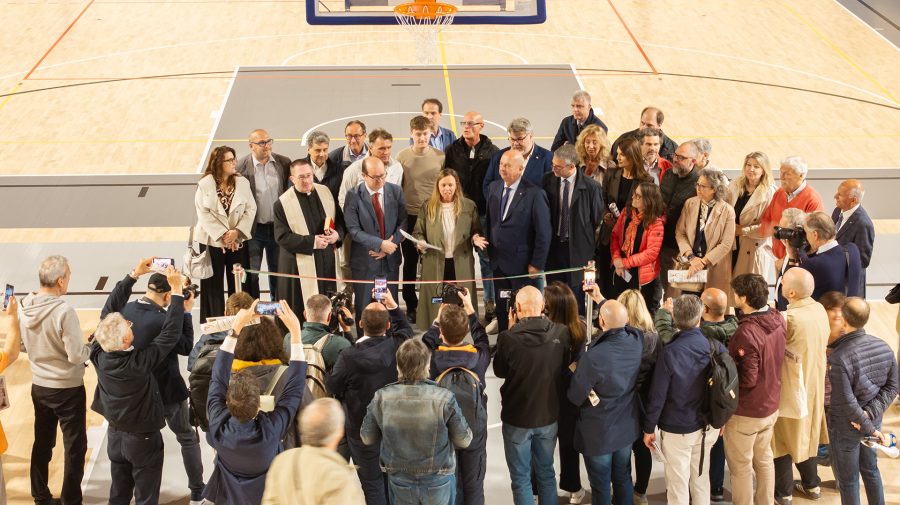
City officials on Tuesday inaugurated a new multi-purpose sports complex in the San Giovanni neighborhood, marking the completion of a project aimed at expanding access to modern athletic facilities in a semi-peripheral area of the city.
The complex, located near the intersection of Viale Raffaello Sanzio and Via San Cilino, includes two indoor gyms built on the site of a former industrial structure once used by the municipal tram system and later as a warehouse. The area is well connected by public transportation and includes nearby public parking.
Mayor Roberto Dipiazza, speaking at the opening ceremony alongside local and regional officials, described the project as a long-awaited addition to a district with deep personal significance. He recalled visiting the area as a child and hearing early plans for sports facilities that have only now come to fruition. “Today we inaugurate a structure that enriches a neighborhood already important for sports,” he said.
Elisa Lodi, the city’s councilor for sports and public property, emphasized the collaborative nature of the project, which received support from the Friuli Venezia Giulia region. She noted that the €4.3 million investment resulted in a modern, accessible facility designed to serve a wide range of users, including people with disabilities. “This is a space dedicated above all to young people,” she said, adding that the complex will remain under municipal management.
Regional officials also framed the project as part of a broader investment in public well-being. Vice Governor Mario Anzil described sports infrastructure as a tool for improving quality of life, while Pierpaolo Roberti, a regional councilor, highlighted the transformation of a long-neglected site into a new hub for community activity.
The facility includes two regulation-sized gyms, each 7.5 meters high, designed to host basketball, volleyball, and five-a-side soccer. The layout allows for multiple activities to take place simultaneously, with spaces for training and local competitions. One of the courts includes seating for spectators with a separate entrance.
Additional features include locker rooms, referee facilities, administrative offices, storage areas, and a first-aid room. A semi-basement level houses athlete access points and changing areas. The entire complex is fully accessible.
The project also included structural upgrades, new internal layouts, roofing and insulation improvements, and the installation of modern systems and finishes. A new medium-voltage electrical substation was built to support both the facility and the surrounding neighborhood.
Following the ceremony, the complex was formally opened to the public.