




















by Maximiliano Crocamo
Interviews: Alessia Rosolen, Councilor for Labor, Education, Training, and University; Andrea Mascaretti, Member of the Chamber of Deputies. Founder and president of the Parlamentary Intergroup of the Space Economy
Trieste became the center of Italy’s space and underwater technology strategy this week as policymakers, industry leaders and researchers gathered for the third edition of the Stati Generali della Space Economy, a national forum dedicated to shaping the country’s future in advanced aerospace and maritime innovation.
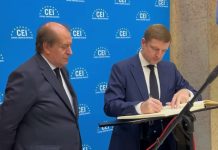
The working session, organized by the Interparliamentary Group on the Space Economy, brought together representatives from government, universities and some of Italy’s largest technology companies to discuss how space exploration and underwater industries are increasingly connected.
Regional Councillor Alessia Rosolen said Friuli Venezia Giulia was selected to host the event because of its longstanding investment in both sectors.
She pointed to the region’s industrial ecosystem, including Fincantieri and Leonardo, as well as its distinction as the only Italian region with a formal partnership with the Polo Nazionale della Subacquea, Italy’s national underwater technology hub. The objective, Rosolen said, is to strengthen collaboration between research institutions, innovative companies and manufacturing as the private sector assumes a larger role alongside national space agencies.
Discussions ranged from existing infrastructure—including submarine telecommunications and energy cables—to emerging technologies such as satellite constellations, orbital data centers and what participants described as the developing “Lunar Economy.”
Organizers highlighted Italy’s expanding role in international space exploration. They noted that Italian astronaut Luca Parmitano is expected to participate in a new European mission next year, while a lunar habitat module designed to support astronauts during extended stays on the Moon will be manufactured in Italy.
The Trieste meeting is one of 20 regional sessions being held across 16 Italian regions with established space industry districts. Each gathering will produce policy recommendations that will be consolidated during a national plenary assembly in Milan later this autumn, alongside a separate session focused on young professionals entering the sector.
The Interparliamentary Group, which includes more than 50 deputies and senators, was created to encourage cooperation between lawmakers, businesses, research centers and universities. Organizers said one of its priorities is addressing the growing shortage of highly skilled workers needed by Italy’s rapidly expanding aerospace industry.
Speakers also pointed to changes in the global space economy, citing NASA’s increasing reliance on purchasing services from private companies rather than directly managing every stage of spacecraft development. They referenced commercial satellite networks, including SpaceX’s Starlink constellation, as examples of how private investment is already improving internet access, telemedicine and remote work in previously underserved areas.
Participants said Italy’s next challenge will be ensuring that public investment, private enterprise and academic research evolve together as the country seeks a larger role in the global space economy.