










by InTrieste
Regional funding aims to speed up long-delayed railway improvements, while construction of the strategic Gorizia rail junction is expected to start by the end of 2026.
TRIESTE, Italy — The Friuli Venezia Giulia regional government is moving forward with a series of railway infrastructure projects in the Gorizia area, including an initiative to accelerate the installation of noise barriers and the long-awaited construction of the Gorizia freight rail junction, known as the lunetta.
Cristina Amirante, the regional councillor for infrastructure, said the region has allocated its own funds to anticipate acoustic protection measures that are otherwise scheduled under Italy’s national railway noise reduction plan, which spans 15 years.
Under Regional Law 13/2024, Friuli Venezia Giulia introduced legislation allowing the region to work with Italy’s railway infrastructure manager, Rete Ferroviaria Italiana (RFI), to bring forward noise mitigation projects affecting homes and businesses located near railway lines.
The national program, launched in 2004, has progressed slowly, with only the first four phases partially completed using state funding. In Friuli Venezia Giulia, most planned interventions are scheduled for the final years of the program, while the 10 projects affecting the Gorizia area fall between the ninth and fifteenth years.
A letter of intent signed between the region and RFI at the end of 2025 established a framework for experimental projects, and on Aug. 7 the regional government approved the first two pilot interventions following a joint technical assessment.
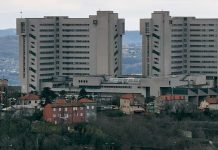
Amirante said the pilot phase would help define the criteria for expanding future noise reduction projects, including potential measures near Gorizia’s hospital district.
The region also confirmed that construction of the Gorizia lunetta—a rail connection designed to improve freight transport and strengthen logistics in the Isontino area—is expected to begin before the end of 2026.
Beyond freight infrastructure, regional investment has also focused on passenger mobility. Recent completed works include the modernization and expansion of Gorizia’s primary intermodal transport hub, integrating the railway station with the city’s bus terminal to improve connections between rail and local public transport.
The regional government also plans to continue supporting the direct cross-border rail service linking Venice Mestre, Pordenone, Udine, Gorizia and Nova Gorica. The route, introduced as one of the flagship transport initiatives of the GO!2025 European Capital of Culture project, has been extended through 2026.
Officials say the combined investments are intended to improve freight logistics, passenger accessibility and environmental quality while reinforcing rail’s role in the long-term development of the Gorizia region.