























by InTrieste
Italy’s longest river has fallen to roughly one-third of its historical flow after weeks of extreme heat and limited rainfall, intensifying a water crisis across the Po Valley that is affecting agriculture, drinking water supplies and river navigation.
According to the latest report from the Po River Basin Authority’s permanent water-use observatory, which met Aug. 6, flows at several monitoring stations were well below seasonal averages. At Piacenza, the river was carrying 177 cubic meters of water per second, compared with a historical average of 497. At Cremona, the figure was 193 cubic meters per second, against 602 normally recorded. Near the mouth of the river at Pontelagoscuro, flow had fallen to 246 cubic meters per second, far below the 450-cubic-meter threshold considered critical.
The decline has been particularly visible around Cremona, where the river reached 8.59 meters below the hydrometric zero point, setting a new low and surpassing the previous record recorded during the drought of 2022.
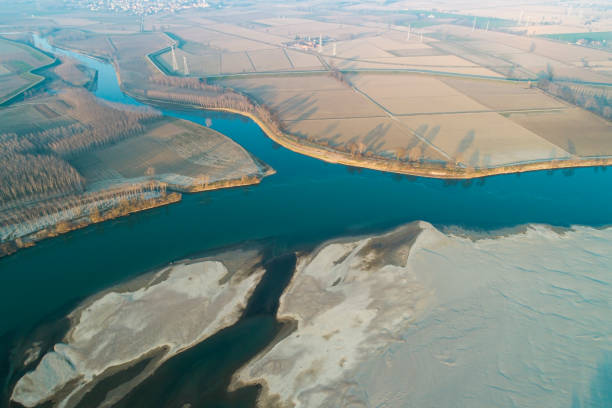
In some stretches between Cremona and Casalmaggiore, exposed sandbanks have narrowed the river considerably, while boats normally used along the waterway have been left stranded. Cremona authorities have canceled the traditional mid-August Assumption procession by boat between Cremona and Brancere because water levels are too low for navigation.
Local officials and agricultural groups have called for emergency measures. The president of Cremona’s province has asked Lombardy to declare a regional state of emergency, a request supported by municipalities along the river.
Alessandro Delpiano, secretary-general of the Po River Basin Authority, said recent thunderstorms in parts of Emilia-Romagna and Veneto had done little to reverse the broader decline.
“Isolated summer storms are not enough to compensate for the deficit,” he said, noting that water levels in both rivers and lakes had continued to fall while demand for irrigation remained high, particularly in rice-growing areas.
Lakes Offer Little Relief
The Alpine lakes that normally help sustain the Po system have also been depleted. Lake Iseo has entered a state of extreme drought, while Lake Maggiore is experiencing severe water shortages. Both have recorded declining levels since June.
Reservoirs across the basin are currently about 45 percent full, roughly 35 percent below the level recorded at the same time last year.
The low river discharge has created another problem downstream: saltwater is moving inland through the Po Delta. Seawater has reportedly penetrated as far as 20 to 25 kilometers upstream, threatening fruit and vegetable production in parts of Veneto and Emilia-Romagna.
Authorities have restricted agricultural withdrawals from the river in the delta, while farmers have proposed installing movable barriers modeled on Venice’s MOSE flood-defense system to limit the advance of saltwater along the Po di Pila branch.
Officials have estimated that such a project could take as long as a decade and cost between €25 million and €100 million.
Farmers have also called for stricter enforcement of minimum-flow requirements, arguing that water-intensive irrigation practices farther upstream contribute to the depletion of the river before it reaches the delta.
Agriculture and Drinking Water Under Pressure
The effects extend beyond agriculture. More than 100 municipalities in Piedmont and Lombardy are struggling to maintain reliable drinking-water supplies, with some communities using tanker trucks to replenish reservoirs.
The most vulnerable areas include hill and mountain communities, where alternative water sources are limited. In Valle d’Aosta, water availability has been about 20 percent below normal over the past six months. The Dora Baltea River is also running below its seasonal average, while reduced water availability has affected fodder production in mountain pastures.
Rice, corn and fruit crops are among those considered most vulnerable. Agricultural organizations have warned that a prolonged drought could produce harvest losses of as much as 30 percent, comparable with the damage recorded during the 2022 drought.
To preserve water in the river system, the basin authority and regional governments have asked hydroelectric operators to reduce withdrawals. The navigation lock at the Isola Serafini hydroelectric plant near Piacenza has also been temporarily closed to boat traffic.
Calls for Emergency Measures
Piedmont’s regional government has begun seeking a declaration of natural disaster status that could unlock financial assistance for agricultural businesses affected by the drought.
Farmers’ organizations, including Coldiretti, Confagricoltura and Cia, have warned that the lack of rainfall in recent months is threatening crops across northern Italy.
Forecasts for the coming days call for scattered summer storms rather than widespread rainfall, offering limited prospects for a significant recovery.
For the Po Valley, the concern is no longer simply the absence of rain. The combination of depleted reservoirs, sustained irrigation demand, shrinking river flows and advancing saltwater is placing pressure on a water system that supports one of Italy’s most important agricultural and industrial regions.
Authorities have warned that, without a substantial change in weather conditions, the most difficult phase of the crisis could still lie ahead.