

















by Nina Vaclavikova
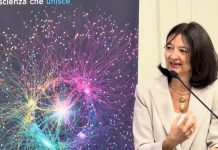
Interviews: Muzio Bobbio president of the Circolo Culturale Astrofili Trieste, spectators
People around the world turned their attention to the sky on Wednesday evening, Aug. 12, as a partial solar eclipse created a striking celestial display shortly before sunset.
In the Trieste area, the eclipse began at 7:26 p.m., with the Moon gradually passing in front of the Sun. The period of greatest overlap lasted only a few minutes, occurring shortly before sunset at around 8:13 p.m.
The event was particularly notable because of the extent of the eclipse. Muzio Bobbio, president of the Circolo Culturale Astrofili Trieste, said that nearly 88 percent of the Sun’s disk would be obscured at the peak of the phenomenon.
Because the Sun was setting at the same time, however, observers in the region could not see the entire period of maximum coverage. Weather conditions also played an important role in determining how clearly the eclipse could be observed.
The experience varied slightly depending on location. Moving from Trieste toward Gorizia, Udine and Pordenone, observers could see a somewhat greater maximum degree of coverage.
For many observers, the eclipse was less about a dramatic change in the sky than about the unusual quality of the light as the Moon passed across the Sun near the horizon.
Similar opportunities will return in the coming years. An eclipse of comparable character is expected in 2027, while a more pronounced event, with greater coverage, is expected in 2031.
Farther into the future, two particularly notable events are expected. An annular eclipse will occur in 2075, while in 2081 Trieste is expected to be in the path of a total solar eclipse.
For those who watched Wednesday’s event, however, the most immediate experience was a brief reminder of the scale of the solar system — and of how a predictable movement of the Moon can bring people together in a shared moment of attention.
Astronomers also emphasized that the spectacle required precautions. Looking directly at the Sun, even during an eclipse, can cause serious eye damage. Certified solar viewing filters are necessary for safe observation.