









by InTrieste
The cultural calendar in Friuli Venezia Giulia opens 2026 with two ambitious museum initiatives that link the region’s Roman past to one of the most important archaeological discoveries of recent decades and to the maritime history of the northern Adriatic.
At the National Archaeological Museum of Aquileia, a major exhibition devoted to the Bronzes of San Casciano is drawing national and international attention less than a month after its opening. Titled “The Gods Return: The Bronzes of San Casciano,” the show presents artifacts recovered from a monumental Etruscan-Roman thermal sanctuary in Tuscany, discovered during excavations between 2022 and 2024.
The exhibition forms part of the cultural program connected to GO! 2025, the European Capital of Culture jointly held by Nova Gorica and Gorizia, and brings to northeastern Italy a collection widely regarded as one of the most significant archaeological finds in Italy in decades.
More than 300 objects are on display, including bronze statues of deities and worshippers, votive anatomical offerings, and hundreds of coins. They were retrieved from the sacred pool of the sanctuary at San Casciano dei Bagni, near Siena, a site that served for centuries as a place of healing where people from different cultural and linguistic backgrounds sought divine intervention for illness and suffering.
The exhibition was curated by Massimo Osanna and Jacopo Tabolli and produced by the Italian Ministry of Culture in collaboration with the National Museums of Friuli Venezia Giulia and the Archaeological Museum of Aquileia.
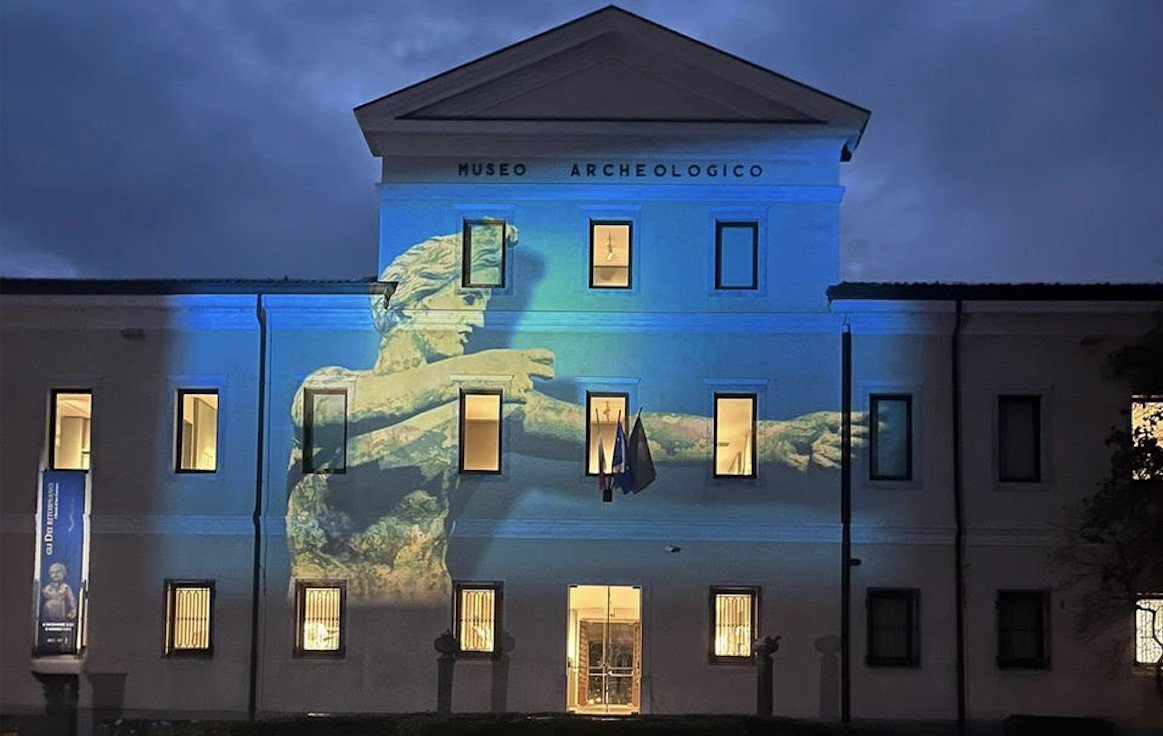
To mark the holiday season, the museum has also introduced a nighttime video-mapping installation that projects images of the bronzes and the sanctuary onto the museum’s façade. Each evening through the Epiphany, the illuminated display visually extends the exhibition beyond the galleries, transforming the museum’s exterior into a moving narrative of ancient ritual and devotion.
Visitors have several opportunities to see the exhibition during the early days of the year. On Sunday, January 4, the museum will participate in Italy’s nationwide Domenica al Museo program, which offers free admission to state museums on the first Sunday of every month. For the Epiphany holiday, the museum will also remain open on January 5 and 6, from 10 a.m. to 7 p.m. (last entry at 6 p.m.). Guided tours organized by PromoTurismo FVG are available on weekends and holidays.