















by InTrieste
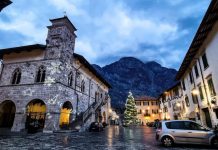
Nearly five decades after the 1976 earthquake devastated Friuli, a new immersive installation will use light, music and digital projections to tell the story of the reconstruction of Venzone Cathedral, one of the region’s most significant architectural landmarks.
Titled Le Pietre Ricordano (The Stones Remember), the installation will open on Nov. 29 at the Cathedral of Sant’Andrea Apostolo in Venzone and remain on view through Jan. 31, 2027.
The project, presented on Monday at the Friuli Venezia Giulia regional government headquarters in Udine, has been organized and curated by the Regional Agency for Cultural Heritage (Erpac). Through video mapping, animated lighting and original musical compositions, it will retrace the destruction of the cathedral and the painstaking process through which it was rebuilt.
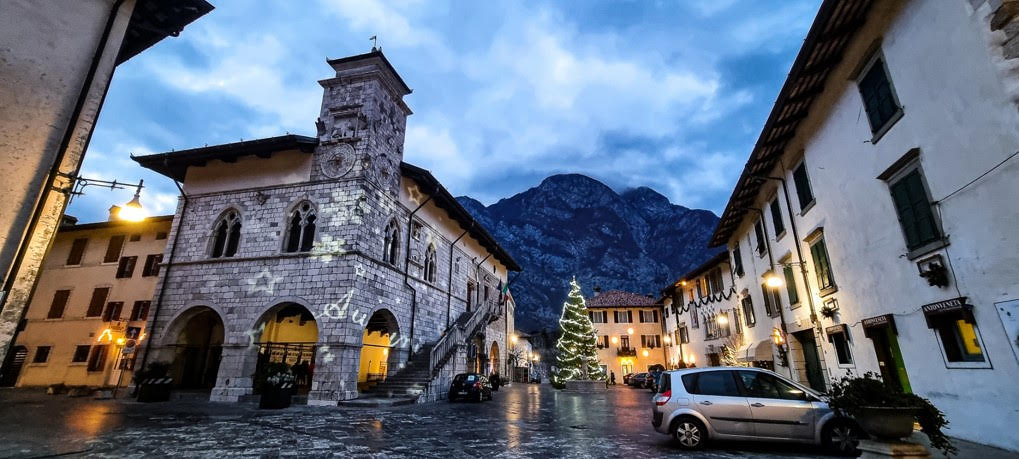
The earthquake of May 6, 1976, reduced much of Venzone to rubble. In the aftermath, residents played a central role in preserving the town’s medieval identity, insisting that the stones of the damaged cathedral should not be removed or discarded.
That decision helped make possible an ambitious restoration based on anastylosis, a technique in which the original architectural fragments of a building are identified and reassembled. Approximately 9,000 stone elements were recovered and repositioned, allowing the cathedral to regain much of its original appearance.
The reconstruction became one of the most emblematic examples of Friuli’s post-earthquake recovery, reflecting the principle of rebuilding a monument as it was and in its original location.
The installation draws on historical and technical research, including architectural drawings by Francesco Doglioni, an Italian scholar specializing in restoration. The plans, construction details and different stages of the cathedral’s reconstruction have been translated into digital images, animations and light sequences designed to explain how thousands of individual stones were identified and put back into place.
The presentation will also include symbolic references to the Friulian sky in the days following the 1976 earthquakes, connecting the architectural story with the collective experience of the disaster.
Mario Anzil, the regional vice governor responsible for culture, said the project was intended to introduce younger generations to the history of the reconstruction while exploring new ways of presenting cultural heritage.
Barbara Zilli, the regional finance councilor, said the initiative also recognized the determination of Venzone’s residents, whose insistence on preserving the original stones helped shape the restoration.
Music will play a central role in the installation. The Filarmonici Friulani Youth Orchestra, the project’s artistic partner, has prepared original compositions to accompany the projections. The music will also be performed live during the opening evening.
The inauguration has been scheduled for Nov. 29, the eve of the feast day of St. Andrew, the patron saint to whom the cathedral is dedicated.
The opening program will begin at 4:45 p.m. with guest reception, followed by a concert by the youth orchestra at 5:30 p.m. Institutional remarks are scheduled for 6:15 p.m., with the first presentation of Le Pietre Ricordano beginning at 6:35 p.m., accompanied by live music. Additional screenings will take place at 7:20 p.m. and 8:05 p.m.
Admission to the opening event will be free, but reservations are required. Bookings are scheduled to open on Nov. 24 through the official websites of the Friuli Venezia Giulia regional government and Erpac.
From Nov. 30 through Jan. 31, the installation will be open to visitors free of charge. Each projection will last approximately 15 minutes.
On weekdays, screenings will take place at 6 p.m., 6:30 p.m., 7 p.m. and 7:30 p.m. On public holidays, six sessions are scheduled, beginning at 5 p.m. and continuing at half-hour intervals until 7:30 p.m.
Through the combination of historical research and contemporary technology, the project aims to preserve the memory of the earthquake while documenting the collective effort that restored one of Friuli’s most recognizable monuments.