









by InTrieste; report by Nastassja Martin
The waters of the Gulf of Trieste will become a classroom of sorts during Barcolana 58, with exhibitions, scientific demonstrations and educational programs focused on the ocean and its ecosystems.
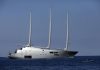
Wendy Schmidt, the American philanthropist and sailor who won the 54th Barcolana aboard Deep Blue, is returning to Trieste with a program that brings together marine research, technology and conservation.
At the center is the Deep Blue Exploration Zone in Piazza Unità d’Italia, developed with BioMa. This year, the exhibition will focus on seagrass meadows, important habitats for marine biodiversity and carbon storage.
Among the technologies on display will be Grasshopper, a robotic system developed by Reefgen with support from Schmidt Marine Technology Partners. The system is being developed to help mechanize parts of seagrass restoration work traditionally carried out by divers. Blue-Tides will also present a structure designed to support bivalves, exploring how their natural filtering abilities could contribute to restored marine habitats.
The educational component has already drawn strong interest. Twenty-seven school classes, representing about 500 students, have booked guided visits to the exhibition.
Shark conservation will be another focus. On Monday, a screening of Shark Preyed. Lo squalo nel piatto will examine the trade in shark meat between Italy and Spain. Andrea Spinelli, one of the documentary’s authors, will join researchers working on shark conservation. The program will also present research on rays, or eagle rays, observed along the Trieste coast during the summer.
A new attraction this year is “The Ocean in Me,” an immersive 10-minute experience developed with Piano B. Visitors will move from images of outer space into footage of the deep ocean, including material recorded by SuBastian, the remotely operated vehicle used by the Schmidt Ocean Institute during scientific expeditions.
The installation is intended to illustrate the connections between the ocean, climate, biodiversity and human life. Visitors will also be able to follow future deep-sea expeditions through live streams.
Students will feature prominently in the program. Through the Ocean Research Challenge, students from UWC Adriatic are developing projects addressing marine and environmental challenges. They will present their work during Barcolana, while Schmidt is scheduled to meet a group of students on Saturday, Oct. 10.
The Sail and Science Program, developed with BioMa and the Società Velica di Barcola e Grignano, will continue to use sailing as a way of introducing young people to marine science.
The program will extend beyond Trieste as well. On Oct. 12, a new immersive room dedicated to the fin whale will open at the Museum of Underwater Archaeology in Grado. The installation builds on a project begun in 2025 to recover and display the skeleton of a fin whale.
Taken together, the initiatives reflect a broader effort to bring marine science closer to the public — from the seagrass beds of the Adriatic to the largely unexplored depths of the world’s oceans.