


















by InTrieste
On its third day, the 37th Trieste Film Festival turned the city into a crossroads of cinema, history and cultural inquiry, weaving together screenings, talks and exhibitions that reflected the region’s layered identity and its long-standing dialogue with Central and Eastern Europe.
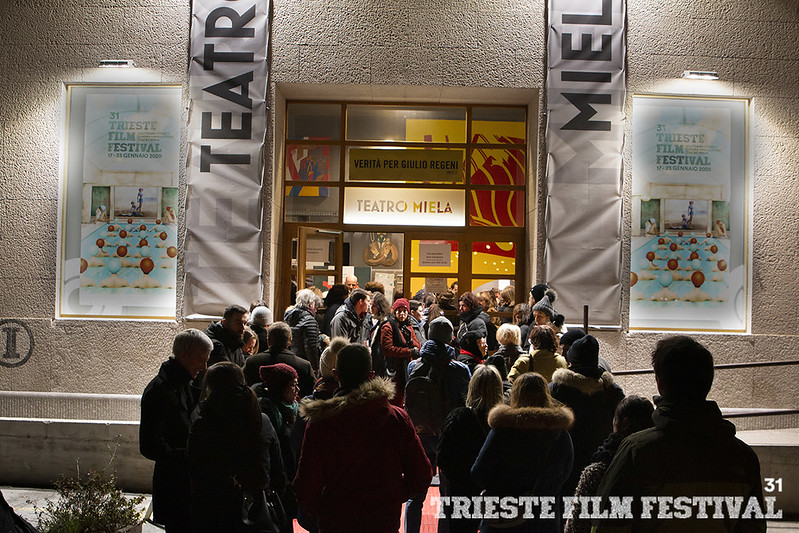
The day opened at Teatro Miela with Cos te costa, a short film by Davide Del Degan, presented out of competition. The 14-minute work follows a woman and her son as they attempt to lay flowers on a family grave—only to discover that the cemetery is split by the former border between Italy and Yugoslavia. The film is part of Cortometraggi senza confini, a series produced for GO!2025, the cross-border European Capital of Culture shared by Gorizia and Nova Gorica, and selected by a jury chaired by Oscar-winning director Gabriele Salvatores.
Questions of borders and memory continued with Ne pozabi me / Non ti scordar di me, directed by Anja Medved. Through the rediscovery of family photographs, the film reconstructs a past shaped by war and political violence in the borderland between Slovenia and Italy. The documentary forms part of the GO!2025 project Memorie ambulanti e brigate d’archivio, which examines how private memory intersects with collective history.
While films unfolded on screen, the festival also extended into the city. A guided walk titled Barriera Stories traced the history of Trieste’s Barriera Vecchia district, highlighting traditions of philanthropy and social care embedded in its urban fabric. Another walking tour, designed for children, invited younger participants to explore the city through a treasure hunt linking sea, hill and neighborhood, emphasizing imagination over technology.
Cinema scholarship found space at the Antico Caffè San Marco, where Roy Menarini presented his book Il film nel XXI secolo in conversation with Beatrice Fiorentino. The discussion addressed how cinema has evolved since 2000, challenging narratives of decline in an era marked by the crisis of theatrical exhibition and the saturation of digital media. Menarini argued instead for a fragmented but vibrant cinematic landscape, capable of responding to contemporary social and geopolitical realities.
The afternoon programming returned to the Wild Roses section, dedicated to women filmmakers from Central and Eastern Europe. Among the highlights was Cent’anni by Maja Doroteja Prelog, which documents an intimate and unsentimental journey through illness, endurance and love, and History of Love by Sonja Prosenc, an earlier work exploring grief through a dreamlike narrative. Both films exemplified the section’s focus on personal storytelling as a lens on broader emotional and social change.
Historical reflection took a sharper turn in the late afternoon with a talk by historian Eric Gobetti, examining how Italian and Yugoslav cinema have represented each other’s roles during World War II. Through clips spanning nearly eight decades, Gobetti traced the evolution of ideological narratives, stereotypes and omissions that continue to shape collective memory on both sides of the former border.
In the evening, the festival’s Visioni Queer section foregrounded contemporary explorations of gender and sexuality. The program opened with Marina by Paoli De Luca, winner of Best Short Film at the Venice Critics’ Week, followed by In Hell With Ivo, a documentary portrait of Bulgarian queer artist Ivo Dimchev, whose work blends provocation, performance and activism. Later screenings included Skin on Skin, shot on 16mm and set in an industrial slaughterhouse in Germany, and Jesteśmy idealni, a Polish documentary examining ambition, visibility and exclusion within the LGBTQ+ community.
Beyond the cinemas, exhibitions expanded the festival’s themes into visual art and design. At Galleria EContemporary, Martina Martonsky’s Beyond Human Skin explored the human body as an ecological system, challenging notions of individuality through video, photography and animation. Elsewhere, a retrospective of Živorad “Zico” Mišić’s work traced connections between comics, science and popular culture, while Yugo Logo, hosted at Cizerouno Cavò, presented more than 600 logos from the former Yugoslavia, offering a graphic history of a country that no longer exists but continues to shape regional visual culture.
Taken together, the day’s events reflected the Trieste Film Festival’s enduring role as more than a showcase of films. In a city defined by shifting borders and layered identities, the festival continues to position cinema as a tool for examining memory, difference and coexistence—on screen, in conversation and across the urban landscape itself.