










by InTrieste
Barcolana president Mitja Gialuz has offered himself as a center-left candidate, while regional governor Massimiliano Fedriga remains a possible contender for the center-right.
The time has come to talk of many things. In Trieste, that includes the political maneuvering ahead of next spring’s mayoral election, even as the vote remains months away.
For weeks, speculation has surrounded the candidates who might seek to lead the capital of Friuli Venezia Giulia. Now, the early positioning is becoming more explicit, with prominent figures on both sides of the political divide signaling their willingness to run.
The most significant development came last week, when Mitja Gialuz, the president of the Barcolana sailing regatta, publicly offered his candidacy to the center-left coalition known as Futuro in Comune. In an interview with the local newspaper Il Piccolo, published on Oct. 21, Gialuz said he wanted to help build a united political alternative to the city’s current administration.
Gialuz, 51, is a criminal law professor at the University of Genoa and a criminal defense lawyer. He has led the organizing body behind the Barcolana since 2014, overseeing the development of an event that has become one of Trieste’s most recognizable international attractions. He also previously taught at the University of Trieste.
His profile combines academic credentials, experience in managing a major public event and a long-standing connection to the city. His relationship with Debora Serracchiani, a Democratic Party lawmaker and former president of the regional government, is another element likely to attract political attention. Gialuz has said that his candidacy is his own initiative, not one directed by his partner.
“I offer my availability to the city and to the center-left coalition for a candidacy in the next municipal elections, in a spirit of unity,” he told Il Piccolo.
He said his priorities would include affordable housing, employment, public safety and better services, as well as rebuilding dialogue between the city administration and its neighborhoods.
But Gialuz’s announcement has added a new complication to an already delicate process within the center-left. Francesco Russo, a Democratic Party politician who ran unsuccessfully for mayor in 2021, is also seeking the nomination. His supporters have been working to demonstrate backing within the local party, while other forces in the prospective coalition have shown interest in a broader candidacy.
The question is not simply which individual can attract the most votes, but how the coalition can settle on a candidate without deepening internal divisions. Adesso Trieste, the civic movement led by Riccardo Laterza, has been reluctant to support Russo, while the Five Star Movement has also been involved in discussions over a shared political program. The possibility of holding primary elections has emerged as one way to resolve the contest, although it remains unclear whether the coalition will choose that route.
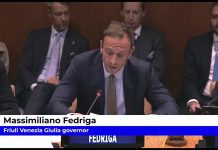
Across the political divide, the center-right has its own high-profile possibility: Massimiliano Fedriga, the governor of Friuli Venezia Giulia and a leading figure in the League.
Fedriga opened the door to a possible mayoral run in an interview with the press two weeks ago, saying that if his party needed him, he would be available. A candidacy by the regional president would carry considerable political weight, but it would also raise questions about the timing of his departure from office and the consequences for the regional government.
Regional elections are scheduled for 2028, meaning that a move to the mayor’s office in 2027 could bring an early end to his current term. Fedriga’s future, however, remains tied to broader decisions within his party and the center-right coalition, not just to the local contest.
Last week, Pierpaolo Roberti, a regional councilor responsible for immigration and local autonomy, also indicated that he would be willing to stand if asked by his political allies. His comments add another name to a field that remains far from settled.
For now, no definitive picture has emerged. Gialuz has offered himself to the center-left, Russo continues to seek support, and the center-right has yet to settle on its candidate. Much will depend on negotiations among parties and movements in the coming months.
There is also a broader question about representation. Trieste has had 12 mayors since the end of World War II, but never a woman in the office. As the parties weigh their options for 2027, a female candidate from either side would offer voters a possibility the city has not yet experienced.
The campaign has not formally begun, but the political atmosphere is already changing. In Trieste, next spring’s election is no longer a distant prospect. It is becoming the subject of the city’s daily conversation.