













by MK
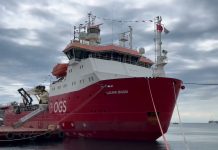
Italy’s Education Minister Giuseppe Valditara visited the Laura Bassi, the country’s only oceanographic icebreaker, on Wednesday, underscoring the government’s support for scientific research, education and the growing role of artificial intelligence in schools.
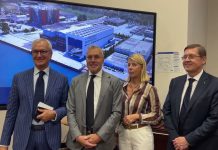
The visit, held at the Port of Trieste, brought together regional and local officials, including Friuli Venezia Giulia Governor Massimiliano Fedriga, Regional Councilor Alessia Rosolen, Trieste Mayor Roberto Dipiazza, Prefect Giuseppe Petronzi and Nicola Casagli, president of the National Institute of Oceanography and Applied Geophysics (OGS), which operates the vessel.
Fedriga described OGS as part of a broader scientific ecosystem that has made Trieste an internationally recognized center for research. He noted that the city has one of the highest concentrations of researchers per capita in Europe, a characteristic he said remains relatively unknown outside the region.
The governor said the regional administration intends to continue making research funding a long-term priority through structural investments, citing ongoing support for institutions such as the Elettra Sincrotrone research centre. He also announced that Friuli Venezia Giulia’s research system will be presented at the United Nations in New York in October as part of an effort to attract international investment and strengthen the region’s global profile.
Valditara reflected on his previous role as head of department at Italy’s Ministry of University and Research, where he helped secure funding for the purchase of the Laura Bassi. He also proposed naming the vessel after Laura Bassi, the 18th-century physicist widely recognized as the world’s first female university professor.
The minister said the ship serves as a symbol of women’s achievements in science and education. He linked Bassi’s legacy to the government’s efforts to promote equal opportunities and combat gender stereotypes through updated civic education guidelines in Italian schools.
“Our goal is to educate young people to overcome stereotypes and reject all forms of discrimination and violence against women,” Valditara said.
The minister also pointed to what he described as improvements in Italy’s education system, including lower school dropout rates, which he said compare favourably with several northern European countries. He argued that reducing early school leaving is essential to improving social inclusion and expanding opportunities for young people.
Addressing the increasing number of foreign students in Italian classrooms, Valditara said the government has recruited 1,000 specialized teachers to support newly arrived students learning Italian. He added that integration initiatives under programs such as Agenda Nord are intended to help schools respond to changing demographics, particularly in northern Italian cities.
Artificial intelligence also featured prominently during the visit. Valditara said the government has invested €100 million in AI initiatives for education, including tools designed to support STEM subjects and personalized learning. Experimental AI-based teaching assistants, he said, are expected to expand to additional schools and regions next year.
Casagli said the Laura Bassi remains Italy’s first and only icebreaking research vessel, acquired by OGS in 2019 with support from the ministry. He credited Valditara, then serving at the Ministry of University and Research, with helping secure funding for the purchase and selecting the vessel’s name in honor of Laura Bassi.
Looking ahead, Casagli said the ship will depart this autumn for its annual mission to Antarctica as part of Italy’s National Antarctic Research Program. After returning to Italy, it is also scheduled to undertake a mission to the Arctic in cooperation with the National Research Council (CNR) and the government.
“The Arctic has become increasingly central to both Italy’s geopolitical agenda and international scientific research,” Casagli said, adding that the additional expedition reflects growing interest in polar research and climate-related studies.