












by InTrieste
Massimiliano Fedriga, the governor of Friuli Venezia Giulia, made a case this week for a greater role for regional economies in shaping the future of global trade, as he addressed a forum on U.S.-Italy economic relations in Washington D.C.
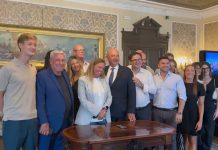
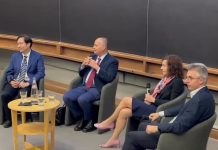
The event, held at the residence of Marco Peronaci, brought together institutional and business representatives to discuss transatlantic cooperation at a time of shifting supply chains and geopolitical realignment.
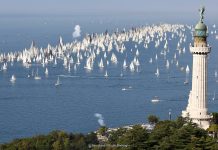
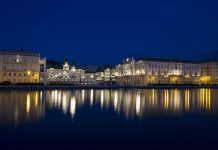
Fedriga pointed to Trieste and its port as a potential strategic hub connecting the Far East with Central and Southern Europe, particularly in light of the proposed India-Middle East-Europe Economic Corridor. The initiative, widely known as IMEC, is expected to play a significant role in reshaping trade routes between Asia, the Middle East and Europe, offering alternatives to existing corridors.
Trieste, long valued for its position at the crossroads of European markets, could see its importance grow if new infrastructure and logistics networks tied to IMEC are realized, Fedriga suggested.
Speaking also in his capacity as president of Italy’s Conference of Regions, he underscored the resilience of economic ties between Italy and the United States, arguing that cooperation has remained steady despite changes in political leadership. The relationship, he said, is rooted in long-term strategic alignment rather than short-term political cycles.
During his visit to Washington, Fedriga also met with Riccardo Ercoli of the International Monetary Fund, where discussions focused on potential initiatives to support economic development in the Balkan region — an area increasingly viewed as integral to Europe’s broader economic future.
Fedriga is accompanied by Sergio Emidio Bini, the region’s councilor for economic development, and his spokesperson, Edoardo Petiziol.