


















by MK
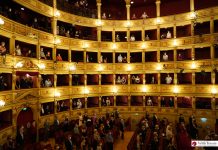
On Friday night at Trieste’s Teatro Verdi, Rise and Fall of the City of Mahagonny announced itself not just as an opera revival but as a pointed theatrical event — abrasive, ironic and deliberately unsettling, much as Kurt Weill and Bertolt Brecht intended when the work first detonated in Leipzig in 1930.
This new production, directed by Henning Brockhaus and conducted by Beatrice Venezi, treats Mahagonny less as a repertory curiosity than as a living provocation. From the outset, it is clear that traditional operatic hierarchies will not apply. Singers frequently abandon the stage, moving through the audience, while dancers occupy the visual center, creating a constant sense of a story within a story, a frame within a frame. What unfolds feels less like a linear narrative than a social experiment observed in real time.
The dancers — mostly young performers — are essential rather than ornamental. Their movement is relentless, their costumes impeccably designed and continuously altered, sometimes stripped away in full view of the audience. These gestures, paired with the singers’ pointed physicality, often allude to erotic transactions, boredom and moral exhaustion. In Brockhaus’s vision, pleasure is not celebratory but compulsory, a currency rather than a joy.
Unlike the classical operatic experience, where the voice reigns supreme, Mahagonny keeps redirecting attention elsewhere. Conversations overlap with sung passages, blurring the line between speech and music, while the German libretto — delivered without compromise, save for an Italian-speaking announcer — reinforces the work’s alienating edge.
Visually, the production leans into contemporary imagery. Many of the male characters wear garish Hawaiian shirts, an ironic shorthand for artificial leisure and tropical fantasy, suggesting a city trapped in perpetual heat and deeper spiritual stagnation.
Musically, the evening is uneven by design. The first act can feel talk-heavy, almost willfully withholding melody, as Brecht’s didactic instincts dominate. But momentum builds decisively in the second act, where Weill’s sharp-edged score asserts itself with greater force.
Venezi’s conducting grows more expansive here, drawing warmer, more elastic playing from the orchestra. Her return to the pit after intermission was greeted with audible cries of “brava, brava,” a rare show of public enthusiasm at Teatro Verdi that continued to ripple through the act.
By the final curtain, Mahagonny remains a curious, confrontational opera that asks more questions than it answers, rich in images, vivid in language and disturbingly contemporary in its diagnosis of a society organized around consumption, spectacle and punishment.
The evening closed with seven minutes of sustained applause for Venezi and the entire cast, a rare and emphatic endorsement for an opera that challenges rather than comforts.