





















interviews: Maximiliano Crocamo
As Rome moves this January to impose a 30-kilometer-per-hour (19-mile-per-hour) speed limit across its historic center, it marks one of the most ambitious traffic-calming measures ever attempted in the Italian capital. The decision has already reignited a national debate over how cities balance road safety, mobility and economic life — a debate now resonating far beyond Rome, including in city of Trieste.
The discussion comes at a moment of uncertainty for similar initiatives elsewhere. Just days ago, an administrative court in the Emilia-Romagna region annulled Bologna’s much-discussed “Città 30” policy, which set a 30 km/h speed limit across most of the city. The ruling, which upheld a complaint brought by taxi drivers, determined that such limits cannot be imposed wholesale but must instead be justified on a street-by-street basis.
Together, the developments underscore both the momentum behind — and resistance to — a growing European movement to slow urban traffic in the name of safety and livability.
Rome’s sweeping change
Rome’s new “Zona 30,” has taken effect on Jan. 15, 2026, applying to all streets within the historic center, largely overlapping with the existing limited traffic zone. Cars, scooters and motorcycles are required to observe the reduced speed throughout the area, including on broad and heavily traveled roads such as Corso Vittorio Emanuele and Via del Teatro di Marcello.
Critics, however, have raised concerns familiar to any Italian city considering such reforms: fears of congestion, longer commute times and negative effects on commercial activity.
Bologna’s legal setback
Those arguments were central to the challenge against Bologna’s Città 30, introduced two years ago by the city’s left-wing mayor, Matteo Lepore. The policy aimed to drastically reduce road deaths by lowering speeds across much of the city, making Bologna one of Italy’s most prominent testing grounds for large-scale traffic calming.
According to municipal data, the results were striking. In its first year, the city recorded a roughly 13 percent reduction in total accidents, a 50 percent drop in fatalities, an 11 percent decline in injuries and a 10 percent decrease in accidents involving injuries.
Despite those figures, opposition was fierce. Taxi drivers, transport associations and members of the national government argued that the policy was overly rigid and disruptive. Transport Minister Matteo Salvini emerged as its most vocal critic, repeatedly calling the initiative “ideological” and accusing it of worsening traffic, inconveniencing workers and harming local businesses.
In its ruling, the regional administrative court sided with the taxi drivers, stating that speed limits must be justified individually and cannot be imposed as a blanket rule across an entire city.
Mayor Lepore has vowed to challenge the decision. “Road victims and their families ask us for this, and we stand with them,” he said, reiterating his administration’s goal of saving lives and preventing accidents. “In these two years, we have shown that it is possible.”
Trieste enters the conversation
While Trieste has no announced plans to introduce a citywide 30 km/h limit, the developments in Rome and Bologna have stirred discussion among residents, urban planners and local officials.
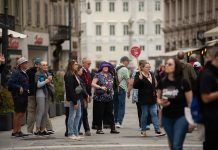
The city’s historic center — stretching from the vast Piazza Unità d’Italia to the old port — is already known for its walkability, cafés and public squares. Many residents say slower traffic could further enhance safety and quality of life, particularly in areas frequented by students and tourists.
“Slower speeds could make the streets safer for children and cyclists, especially around the university and along the waterfront,” said one resident. Another welcomed the idea in principle but wondered how it might affect daily logistics. “It would make walking through the city more pleasant,” she said, “but I’m not sure what it would mean for buses and deliveries.”
Others are more skeptical. Trieste’s narrow streets, steep hills and role as a regional transport hub pose challenges that differ from those of flatter, more compact cities. Some residents worry that a uniform speed limit could increase congestion or complicate movement for commuters who rely on cars to navigate the city’s topography.
A broader European trend
Across Europe, cities from Paris to Brussels and Barcelona have embraced 30 km/h zones as a way to prioritize pedestrians, reduce emissions and reclaim public space. Proponents argue that lower speeds not only save lives but also encourage walking, cycling and local commerce.
Italy’s experience, however, illustrates how difficult it can be to translate that vision into policy. Legal challenges, political opposition and deeply ingrained driving habits have slowed the spread of such measures, even as data from pilot projects suggest tangible safety benefits.
For Trieste, the question is not yet one of implementation but of possibility. Could a city shaped by centuries of trade, migration and movement adapt to a slower pace? Or would its unique geography and traffic patterns demand a more selective approach?