











by InTrieste
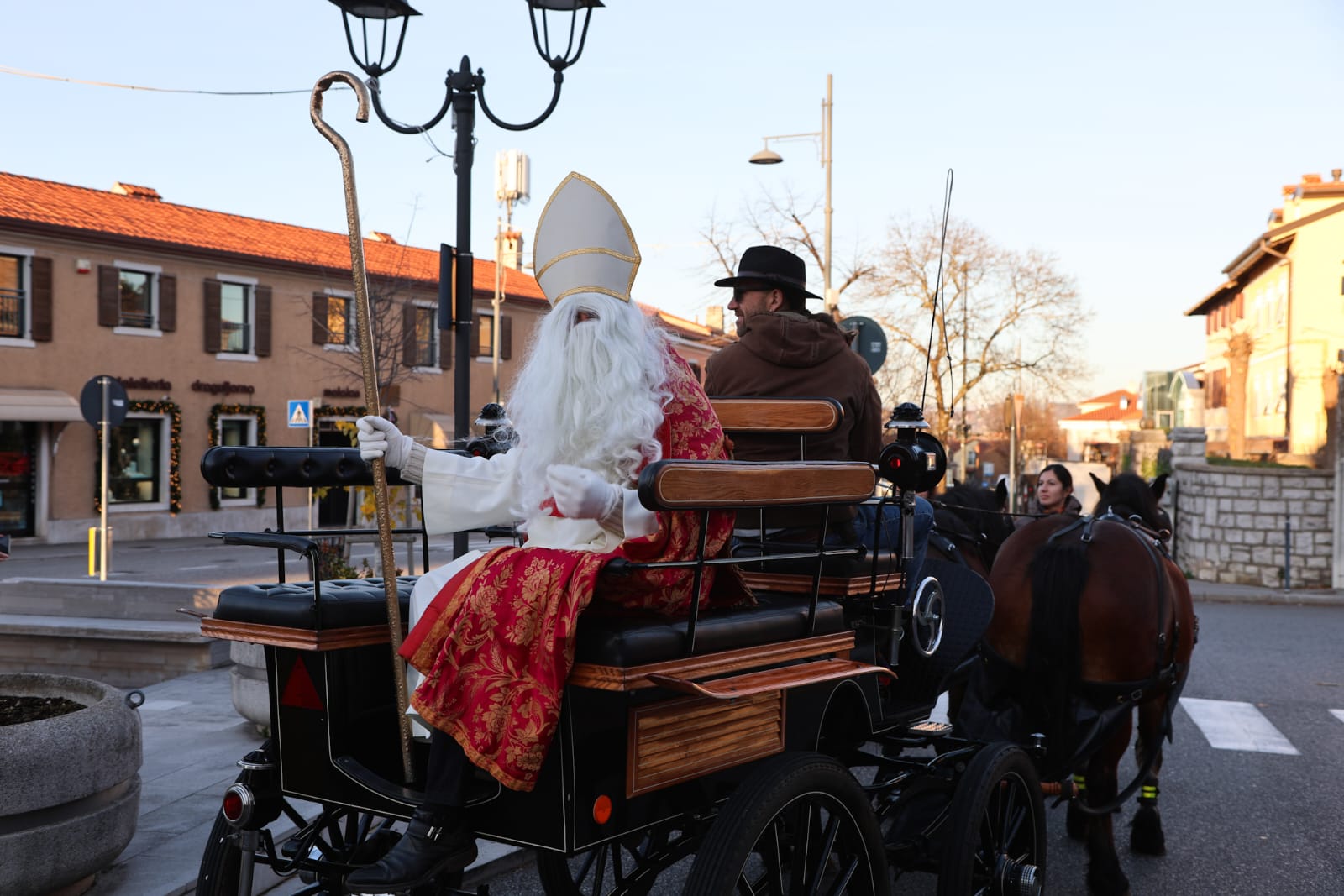
On Sunday afternoon, December 21, the quiet Karst village of Opicina, perched above the Adriatic and just beyond the city of Trieste, will mark the start of its Christmas celebrations with a scene that feels drawn from another era: Santa Claus arriving by horse-drawn carriage.
At 3:30 p.m., in Piazzale Monte Re, Babbo Natale will make his ceremonial entrance, welcomed by families, shopkeepers, and children gathered in the village square. Accompanied by the music of the Viktor Parma Brass Band of Trebiciano, Santa—portrayed this year by Omar Marucelli—will distribute sweets to children before touring the village streets in the carriage, pulled by horses from the Šuc agricultural company.
The event is the most anticipated moment of “Natale con Noi” (“Christmas With Us”), the annual holiday program that transforms Opicina into a festive hub through January 11, 2026. While modest in scale, the celebration reflects the village’s strong sense of community and its role as a cultural crossroads between Italian, Slovenian, and Central European traditions.
Opicina, known in Slovene as Opčine, sits on the Karst Plateau and has long served as a gateway between Trieste and the inland villages. During the Christmas season, its streets and shopfronts are illuminated with holiday lights, and the village becomes a gathering point not only for residents but also for visitors from the city below.
Sunday’s festivities coincide with extended shopping hours, as local businesses open from morning through early evening, offering an alternative to city-center crowds. For many families, the afternoon begins with shopping or a walk through the decorated streets before converging on Piazzale Monte Re for Santa’s arrival.
The square itself is home to a Christmas tree donated by the City of Trieste, as well as one of the village’s most cherished traditions: the handcrafted Nativity scene created by “Nonna Bruna,” who will turn 100 next year. Entirely handmade and expanded annually with new figures, the presepe has become a quiet symbol of continuity, maintained with the help of local volunteer Dario Rota and admired by generations of visitors.
Beyond Sunday’s event, the broader Christmas program includes three Nativity scenes—located at Villa Carsia, along Via di Prosecco, and near the Obelisk—as well as a small Christmas market, children’s activities, exhibitions, and guided tours of historical sites. Among them are visits to the Opicina bunkers and to Kleine Berlin, the vast underground air-raid shelter in central Trieste, reminders of the area’s complex wartime history.
But it is the simplicity of Sunday afternoon that organizers see as the heart of the celebration. “The arrival of Santa is not a spectacle in the modern sense,” said one local shop owner. “It’s a moment when the whole village stops, even briefly, to be together.”
That sense of shared pause is reinforced by the music of the brass band, whose presence evokes long-standing Central European traditions, and by the slow pace of the carriage as it moves through the village streets—an image that contrasts sharply with the commercial intensity often associated with the holiday season.
The “Natale con Noi” initiative is promoted by the local merchants’ consortium Insieme a Opicina, in collaboration with the City of Trieste and the Altipiano Est district council, with support from regional trade associations and cooperative banks. Practical touches—such as free weekend parking offered by a local bank—are designed to encourage visitors while keeping the event accessible.
In Opicina, Christmas does not announce itself with grand displays or large crowds. Instead, it arrives quietly, on a December afternoon, to the sound of brass instruments and the rhythm of hooves on pavement—an old-fashioned welcome that, year after year, continues to draw the village together.