











by Maximiliano Crocamo
Interview: Gian Paolo Dolso Professor of Public Law at the University of Trieste; Paolo Giangaspero, Professor of Constitutional Law at the University of Trieste
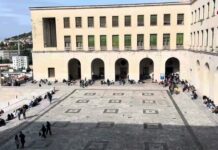
The University of Trieste is hosting Settimana per la Pace (Week for Peace), a series of ten open lectures running from April 13 to 17, 2026, at its Trieste campus. Open to students, residents, and remote participants, the initiative is framed as an academic response to a global landscape increasingly defined by conflict.
The program is part of RUNIPACE (Rete delle Università per la Pace), a national network of Italian universities committed to advancing peace through research and public engagement. All ten departments at the University of Trieste are involved, bringing together disciplines ranging from physics and law to psychology, economics, and education.
“Peace is not treated in abstract terms,” said Prof. Giuseppe Pascale of the Department of Political and Social Sciences, who coordinates the initiative. Instead, he noted, the lectures approach the subject “through the perspectives and tools of different scientific fields,” reflecting the university’s interdisciplinary reach.
The week’s schedule reflects that breadth:
Wednesday, April 15
• 09:00–11:00 — Peace as a Condition for Research, Development and Education, with Prof. Cefalo and Dr. Tewelde, examining peaceful applications of cartography, GNSS, and drone technology through the case of Tigray.
• 14:00–16:00 — Values, Ethics and Business Decisions, with Prof. Rossi, exploring how ethics and cultural values shape corporate governance and sustainability.
Thursday, April 16
• 14:00–15:00 — From Fertilizer to Chemical Weapons: Fritz Haber, with Prof. Rosei, on science’s dual legacy in resource development and warfare.
• 16:00–18:00 — Psychology and Neuroscience for Peace, with Profs. Del Missier and Tongiorgi, focusing on the neurobiological roots of violence, trauma, and moral disengagement.
Friday, April 17
• 13:00–15:00 — Education and Peace: Pedagogical Readings, with Prof. Gola, drawing on figures such as Montessori, Capitini, Lodi, and Galtung to explore education as a foundation for coexistence.
Lectures are held throughout the week in both morning and afternoon sessions, with the option to attend remotely. The full program, including access details, is available on the university’s official website.