




















by InTrieste
Nearly fifty years after a powerful earthquake devastated large parts of northeastern Italy, the Friuli Venezia Giulia region is preparing a yearlong series of commemorations that aim not only to honor the victims of the 1976 disaster, but also to examine what emerged from it: a reconstruction model that has since become a reference point well beyond Italy’s borders.
The program, presented on Monday at the University of Udine, marks the approaching fiftieth anniversary of the Friuli earthquake, which struck on May 6, 1976, killing nearly 1,000 people and destroying dozens of towns. Regional officials described the initiative as an opportunity to reflect on how a profound tragedy reshaped the region’s institutions, civic culture, and approach to emergency management.
“This was a deep wound in our collective history,” said Massimiliano Fedriga, governor of the Friuli Venezia Giulia region, during the presentation. “But it was also the moment when Friuli showed its most authentic character — a community that chose not to give up.” He noted that the reconstruction effort led to the creation of a civil protection system now widely regarded as a model for disaster response and prevention.
The events, coordinated by the regional government and the Friuli Venezia Giulia Civil Protection agency, will run throughout 2026 and extend beyond the region to Rome and abroad. They involve a wide network of institutions, including the University of Udine, local municipalities affected by the quake, religious authorities, business associations, and research institutes.
The reconstruction of Friuli is often cited for its emphasis on local decision-making and institutional cooperation. State authorities, the regional government, and municipalities worked closely together, while political divisions were largely set aside during the emergency phase. One of the most consequential decisions was the prioritization of rebuilding factories before homes and churches, a strategy aimed at preserving employment and preventing depopulation in the affected areas.
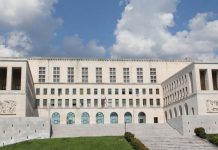
The University of Udine itself, founded in the aftermath of the earthquake, was highlighted as a lasting legacy of that period. Conceived through strong public support, the university was intended to educate a new generation capable of guiding the region’s recovery and long-term development.
Several of the planned events will take place in sites directly connected to the earthquake and its aftermath, including Gemona del Friuli, one of the towns most severely damaged in 1976. A solemn religious ceremony and a concert are among the flagship initiatives, alongside conferences, exhibitions, and educational programs.
The presentation also included the unveiling of the official logo for the fiftieth anniversary, selected through a competition involving high school students across the region. The winning design, created by Davide Giroldo of the Galvani Art High School in Cordenons, symbolically represents destruction, resilience, and rebirth. The logo will be used throughout 2026 for all regional initiatives, including those not directly tied to the anniversary.
For Friuli Venezia Giulia, officials said, the anniversary is not intended as a retrospective exercise alone. Instead, it is meant to reaffirm a vision born out of crisis — one that links memory, institutional responsibility, and a long-term commitment to prevention and community cohesion.
As Fedriga put it, the spirit of reconstruction “is not something that belongs only to the past, but a force that continues to define the present.”