












report: Nina Vaclavikova
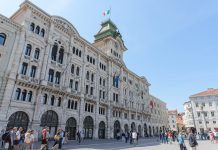
From Jan. 16 to Jan. 24, the 37th Trieste Film Festival will bring more than 120 screenings and events to the northeastern Italian port city, reaffirming its role as Italy’s most important showcase for Central and Eastern European cinema.
Founded more than three decades ago, the festival has become a key meeting point between Eastern and Western European film cultures, spotlighting works from countries often underrepresented on mainstream international circuits. The 2026 edition, directed by Nicoletta Romeo, will take place across three venues — the Politeama Rossetti, Teatro Miela, and Cinema Ambasciatori — and will include feature films, documentaries, short films, masterclasses, and public discussions.
Opening and Closing Films
The festival will open on Jan. 16 with the Italian premiere of “Franz,” a biographical film about Franz Kafka directed by Agnieszka Holland, one of Poland’s most prominent filmmakers. The film, Poland’s submission for the 2026 Academy Awards, traces Kafka’s life from his childhood in 19th-century Prague to his death in post-World War I Vienna.
A second opening event on Jan. 20 at the Politeama Rossetti will feature “The Disappearance of Josef Mengele,” by Kirill Serebrennikov, which had its world premiere in Cannes. The film examines the postwar life of the Nazi doctor who fled to South America after World War II. Serebrennikov will also lead a public masterclass on Jan. 21.
The festival will close on Jan. 24 with “Silent Friend,” by the Hungarian director Ildikó Enyedi, which was previously shown in competition at the Venice Film Festival and shortlisted for the European Film Awards. Enyedi will also hold a masterclass that day.
Competitions and Special Sections
Three international competitions will be held for feature films, documentaries, and short films, alongside a separate competition dedicated to Italian productions.
The program also includes several curated sections, among them:
- “Queer Visions,” focusing on LGBTQ+ stories
- “Wild Roses,” dedicated to women filmmakers
- A historical retrospective titled “The Second Shift: Women at Work”
- TSFF for Kids, aimed at younger audiences
International Directors in Focus
In addition to Holland, Serebrennikov, and Enyedi, the festival will present new films by some of Europe’s most prominent directors, including Christian Petzold, Šarūnas Bartas, Mascha Schilinski, Nastia Korkia, and Ildikó Enyedi. Sergei Loznitsa, a longtime festival favorite, will also return with a new work.
A Longstanding Cultural Bridge
Since its founding, the Trieste Film Festival has been closely tied to the city’s position at the crossroads of Latin, Slavic, and Central European cultures. Over time, it has become an important platform for exploring how the political, social, and historical transformations of the region are reflected in film.
As European cinema continues to grapple with questions of memory, identity, and political change, the Trieste Film Festival remains one of the continent’s key places where those stories are first brought to the screen.