























interview by Nina Vaclavikova
The intense heat wave gripping northeastern Italy is also driving sea temperatures to unusual highs, with parts of the Gulf of Trieste and the Grado Lagoon recording some of the warmest surface waters ever measured by local monitoring systems.
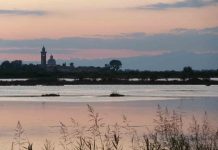
According to the National Institute of Oceanography and Applied Geophysics (OGS), which operates a network of oceanographic monitoring stations in the Gulf of Trieste, the highest temperature was recorded on June 29, when a newly installed buoy in the Grado Lagoon measured a surface water temperature of 32.12 degrees Celsius (89.8°F).
Farther offshore, near the Miramare Marine Protected Area, OGS’s long-running MAMBO1 buoy registered 28.34°C (83°F) on July 1, one of the highest temperatures observed at the site since monitoring began in 1999.
Scientists say unusually warm seawater can reduce dissolved oxygen levels, placing stress on marine species adapted to cooler conditions while encouraging the spread of organisms typically found in warmer seas. Continuous monitoring helps researchers track these changes and assess their effects on coastal ecosystems, while also providing data for environmental management and civil protection authorities.
“The continuous public access to data from the Gulf of Trieste monitoring network allows not only scientists but also citizens to follow the evolution of marine conditions in real time,” said Alessandra Giorgetti, head of OGS’s National Oceanographic Data Center. The system provides live information on water temperature, salinity, dissolved oxygen, chlorophyll and turbidity.
The observations are collected through the Gulf of Trieste Marine Observatory, an integrated monitoring network that combines oceanographic buoys, long-term field sampling and numerical modeling. Marina Lipizer, an oceanographer at OGS, said the project relies on collaboration across multiple scientific disciplines, from maintaining offshore instruments to validating and publishing real-time data.
Cosimo Solidoro, director of OGS’s Oceanography Section, said the observatory was designed to provide continuous physical, chemical and biogeochemical measurements of the coastal environment. Beyond supporting regional environmental monitoring, the network also contributes to European marine research initiatives, including JERICO-RI and DANUBIUS-RI, and has received funding through Italy’s National Recovery and Resilience Plan.
The monitoring data are publicly available through OGS’s recently updated marine data geoportal, allowing researchers and the public to follow changing sea conditions as the summer heat continues.