
















by InTrieste
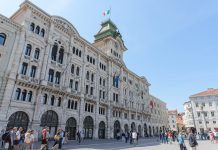
In a city where history is layered like sediment beneath its grand façades, few places have absorbed as much of Trieste’s public life as Piazza Unità d’Italia. Now a new exhibition at Palazzo Gopcevich brings that story into focus, using more than a century of photography to trace how the square has evolved from a bustling imperial port to a modern civic stage.
“La Fototeca in piazza. Scatti di storia e storie,” on view in the Sala Selva through April 6, draws from the extensive archives of Trieste’s Fototeca to present a visual chronicle of the square and the Palazzo Municipale that anchors it. The exhibition also marks the 150th anniversary, celebrated in 2025, of the construction of Trieste’s City Hall, a building whose ornate presence has long defined the square’s architectural and symbolic identity.
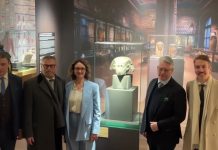
The exhibition opens its public programming on Thursday, January 8, 2026, at 11 a.m., with a guided tour led by the curator, Claudia Colecchia.
More than 40 photographers are represented, among them Carlo and Giuseppe Wulz, Ferdinando Ramann, Carlo Wernigg, Pietro Opiglia, Adriano de Rota, Ugo Borsatti, Tullio Stravisi, Gianni Berengo Gardin, Franco Fontana and Marino Sterle, along with the historic photo agency Giornalfoto. Together, their images form a long, uneven timeline of urban change, capturing both monumental events and fleeting everyday scenes.
The earliest photographs show a square that looks strikingly different from today’s expansive open space. An orderly 19th-century garden once bordered the piazza, while shops, barber stalls and street vendors crowded its edges. Horse-drawn carts and early trams filled the streets, and tall-masted sailing ships in the background underscored Trieste’s role as one of the Habsburg Empire’s most important ports.
Later images reflect moments of national and local upheaval. Photographs from 1918 record the tense anticipation of ships arriving at the end of the First World War. Images from 1953 document violent protests during the final years of the Allied Military Government, while 1954 brings scenes of celebration as Trieste formally returned to Italian sovereignty.
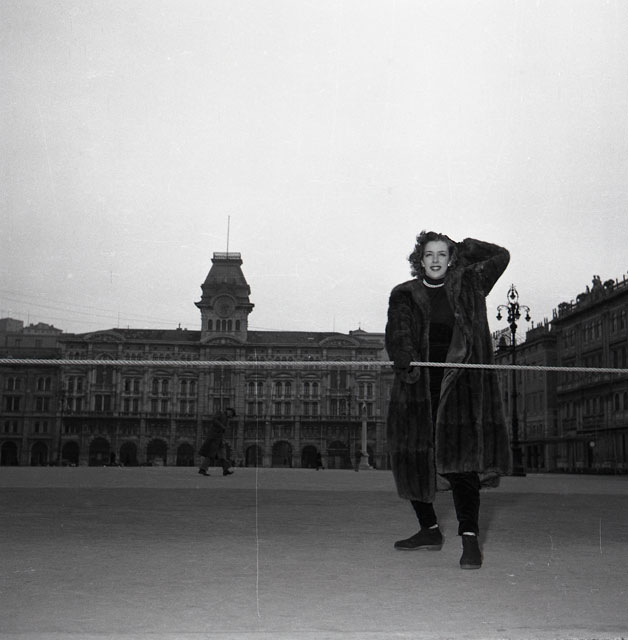
But the exhibition also dwells on the rhythms of ordinary life. The square whipped by the fierce bora wind; a film crew shooting Senilità, with a young Claudia Cardinale on set; sporting events; and the many reincarnations of the Fountain of the Four Continents — all appear in photographs that treat the piazza as a living, contested space rather than a static postcard.
Assembled alongside the images is a small collection of objects drawn from daily life, adding texture to the visual narrative. There are children’s hopscotch diagrams, barbers’ razors, coffee cups and a late-19th-century moustache cup, once designed to protect waxed facial hair from hot espresso. A mandolin once offered for sale in the shop of Carlo Schmidl, the music publisher and collector, also appears, along with historic cameras and early tourist guides.
Taken together, these materials portray Piazza Unità d’Italia not only as Trieste’s ceremonial heart, but as a social crossroads — a place where commerce, politics, leisure and identity have intersected for generations.
The exhibition is open from Wednesday to Sunday, from 10 a.m. to 5 p.m., and is closed on Mondays and Tuesdays. Admission is free.