














by Nina Vaclavikova
Interviews: General Manager Giuliano Polo, Artistic Director Valerio Vicari
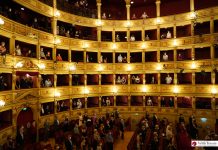
The Teatro Lirico Giuseppe Verdi will begin 2026 by turning its stage over to one of Italy’s most storied dance institutions. From Jan. 9 to Jan. 13, the Ballet of the Teatro dell’Opera di Roma makes its first appearance in Trieste and in the wider Friuli Venezia Giulia region, bringing with it a program that surveys three central figures of 20th- and 21st-century choreography: Roland Petit, Christopher Wheeldon and Krzysztof Pastor.
The six performances form part of the Verdi’s 2025–26 opera and ballet season and are led by Eleonora Abbagnato, the Roman company’s director and étoile, who also appears onstage. Under the baton of the British conductor David Garforth, the Orchestra of the Teatro Verdi accompanies a sequence of four works that move from French modernism to contemporary neoclassicism, set to music by Gustav Mahler, Ezio Bosso, Antonio Vivaldi, Gabriel Fauré and Maurice Ravel.
The evening opens with “La Rose Malade,” a compact but emotionally charged pas de deux created in 1973 by Roland Petit. Inspired by William Blake’s poem The Sick Rose and set to the famous Adagietto from Mahler’s Fifth Symphony, the work explores love, desire and mortality through tightly focused movement. Yves Saint Laurent’s costumes, originally designed for Maya Plisetskaya, remain part of the staging. In Trieste the ballet is danced by Ms. Abbagnato and Giacomo Castellana.
That gives way to “Within the Golden Hour,” Christopher Wheeldon’s 2008 one-act ballet, first created for San Francisco Ballet and later taken up by the Royal Ballet in London. Built around five pieces by the late Italian composer Ezio Bosso, with a closing section set to the Andante from Vivaldi’s Concerto in B-flat major (RV 583), the work reflects Wheeldon’s hybrid style: classical technique animated by contemporary musical phrasing and fluid partnering. In interviews, Wheeldon has described the ballet as an attempt to find “a synthesis between classical ballet and other forms of dance,” and it has since become a staple in major international companies.
Petit returns with “Le Combat des Anges,” a celebrated pas de deux from his 1974 ballet Proust, ou les Intermittences du cœur. Set to Fauré’s Élégie for cello and orchestra, the scene dramatizes the intense and destructive relationship between Saint-Loup and Morel, characters drawn from Marcel Proust’s In Search of Lost Time. In Trieste, the roles are danced by Simone Agrò and Michele Satriano (with Claudio Cocino alternating in some performances).
The program closes with “Bolero,” Krzysztof Pastor’s 2012 reimagining of Ravel’s inexorable score. Departing from the tradition of a single central soloist, Pastor places a couple at the core of the work, surrounded by a rectangular formation of dancers that gradually tightens as the music builds. The result is a study in tension, attraction and collective momentum, one that has already proven popular with audiences in Rome, where it was presented at the Baths of Caracalla.
David Garforth, a specialist in ballet conducting who has worked extensively with the Royal Opera House, the Paris Opéra and La Scala, leads the performances in Trieste. His résumé also includes high-profile broadcast productions and large-scale crossover works, making him a familiar figure beyond the opera house.
The visit by the Rome Opera Ballet also signals a broader moment of renewal for the Teatro Verdi. Alongside the guest company’s debut, the Trieste theater is marking the arrival of its new artistic director, Valerio Vicari, known in Italy for his work with Orchestra RomaTre. Together, the events underline a strengthening of ties between Trieste and the capital’s cultural institutions.
Founded in 1928, the Ballet of the Teatro dell’Opera di Roma is Italy’s oldest continuously operating ballet company. Over nearly a century it has worked with choreographers ranging from Marius Petipa and George Balanchine to Roland Petit, Pina Bausch and, most recently, Wheeldon. Under Ms. Abbagnato’s direction, it has sought to balance classical repertory with 20th-century and contemporary works — an approach reflected in the Trieste program.
The performances take place on Jan. 9 (8 p.m.), Jan. 10 (3 p.m. and 8 p.m.), Jan. 11 (4 p.m.) and Jan. 13 (3 p.m. and 8 p.m.). For the Teatro Verdi, the week offers not just a prestigious guest engagement but a statement of intent for the new year: an opening anchored in international ballet, modernist heritage and the enduring pull of live performance.