























by InTrieste
Mass email bomb threats prompt evacuation of 102 schools across Friuli Venezia Giulia
A wave of bomb threats sent by email forced the evacuation of 102 schools across Friuli Venezia Giulia on Wednesday, as hundreds of schools throughout Italy received messages claiming that explosive devices had been planted inside their buildings.
The messages, which began arriving at 8:51 a.m., were part of what authorities described as a possible cyberattack known as “mail bombing” — the mass distribution of large numbers of emails to targeted recipients. The messages were signed by an individual identifying himself as Mikail Andropov and were reportedly sent from an email address originating in Taiwan.
In Friuli Venezia Giulia, 14 schools in Trieste were among those affected, including the Julia, Deledda, Carducci and Galileo Galilei, and Sacro Cuore schools. At least five institutions in Udine, including the Zanon, Sello and Percoto schools, also received threats, along with schools in Gorizia and Monfalcone.
The emails claimed that explosive devices had been placed inside school buildings and included references to a remotely detonated explosive device. Security procedures were immediately activated, leading to the evacuation of students and staff.
Police and Carabinieri bomb-disposal specialists, canine units and firefighters were deployed to inspect affected buildings. Police patrols were stationed outside schools, with military personnel also assisting security operations. The Interior Ministry was coordinating the response through local police headquarters.
In some cases, the alerts were delayed because threatening emails had been filtered into spam folders, according to police in Gorizia.
The regional director of education, Patrizia Pavatti, confirmed that 102 schools had been evacuated across Friuli Venezia Giulia. She said her office had been working continuously with police headquarters and prefectures since the emergency began.
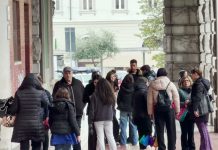
The evacuations caused considerable disruption for families, with parents asked to collect their children from school, often leaving work and adding to traffic congestion. By Wednesday afternoon, the situation appeared to have returned largely to normal, although security inspections were continuing.
The municipalities of Trieste and Udine also ordered the precautionary closure of school gyms and the suspension of sports activities while inspections were carried out. All training sessions scheduled for Wednesday were canceled.
Government response
Prime Minister Giorgia Meloni convened a meeting at Palazzo Chigi on Wednesday afternoon to assess the situation and coordinate the government’s response.
The meeting was expected to include Deputy Prime Ministers Matteo Salvini and Antonio Tajani, Interior Minister Matteo Piantedosi, Defense Minister Guido Crosetto, as well as the heads of Italy’s intelligence services and the National Cybersecurity Agency.
Education Minister Giuseppe Valditara urged the public to avoid alarm, saying the content of the messages suggested there was virtually no concrete danger. He said the incident was more likely to be a cyberattack than a genuine physical threat, while stressing the need to develop a response in consultation with intelligence agencies.
Regional official Roberti said authorities had a responsibility to use all available resources to protect communities, including increased investment in security and cybersecurity. He also said institutions should not be intimidated by organized groups, which he described as often having close links to foreign powers.
“The response must be institutions that are present, aware communities and the utmost attention to protecting citizens,” Roberti said.
Defense Minister Crosetto described the threats as part of a strategy aimed at “sowing worry,” adding that police must distinguish credible threats from hoaxes, which he said could become increasingly common.
Previous incidents and ongoing investigations
The messages are being investigated to establish their origin and the motives behind them. Although media reports have described the warnings as likely false alarms, authorities continued inspections to rule out any actual danger. Investigators also believe that more schools may have received the emails than initially reported.
Similar threats were reported on Nov. 2, when schools across Italy, including institutions in Friuli Venezia Giulia, received emails claiming that explosive devices had been planted. Those warnings also prompted evacuations but were subsequently found to be unfounded.
Schools were expected to reopen normally on Thursday, provided that security inspections had been completed and no risks identified.