

















by InTrieste
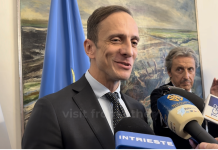
At a regional government headquarters in Trieste on Thursday morning, Italy’s minister for sport, Andrea Abodi, outlined two priorities he said are increasingly shaping the country’s approach to athletic policy: improving the energy efficiency of sports facilities and expanding access to sports for people with disabilities.
Speaking during the presentation of “Sport in Regione. Opportunità e fondi per lo sport regionale,” an initiative attended by the regional governor, Massimiliano Fedriga, Mr. Abodi described rising energy costs and structural inefficiencies as a significant burden on Italy’s sports system.
He estimated that inefficiency in sports facilities costs about €1.2 billion annually — more than double the level of public funding allocated to sports. The figure, he said, reflects the condition of infrastructure managed by a range of entities, including municipalities, private companies and sports associations.
In Friuli Venezia Giulia, about 12 percent of facilities meet energy efficiency standards, a share that is higher than the national average but still limited. Rather than relying on subsidies to offset energy costs, Mr. Abodi said the government is encouraging investment aimed at reducing consumption, noting that improvements could lower energy bills by as much as 40 percent.
The minister also addressed accessibility, particularly in the context of the recent Paralympic Games. He said that while international results have raised the profile of adaptive sports, structural barriers remain, especially for younger athletes.
Among them is the cost of specialized prosthetics and equipment, which can limit participation. Mr. Abodi said the government, in coordination with Parliament and the health minister, Orazio Schillaci, is examining ways to expand existing funding for prosthetics and to include sports-related devices within the national health system’s technical framework.
The measures discussed on Thursday, he said, are intended to address both infrastructure and access, with the region serving as one of several areas where these policies are being developed and tested.