






















by InTrieste
For the first time in its long Carnival tradition, the coastal town of Muggia will introduce controlled access to its historic center during the busiest nights of the celebrations, a move local officials say is aimed at improving safety and crowd management rather than restricting participation.
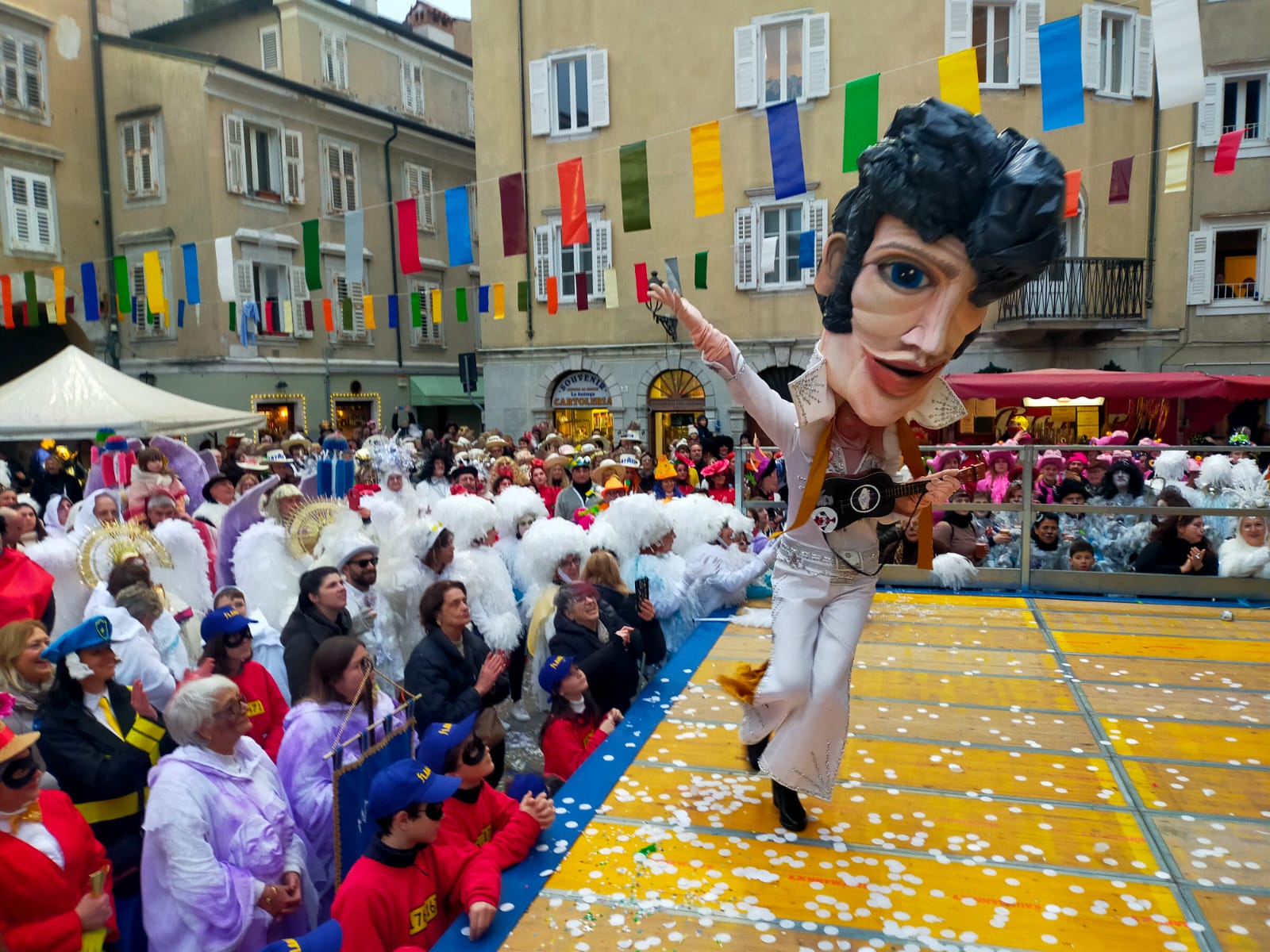
Under a pilot system announced this week, residents of Muggia will continue to move freely throughout the town without fees or digital passes. Non-residents, however, will be required to obtain a QR code to enter the historic center during evening and nighttime hours between February 12 and February 17, 2026, coinciding with the 72nd edition of the Winter Carnival.
The measures were presented at a press conference by Mayor Paolo Polidori, Deputy Mayor Nicola Delconte, who oversees Carnival events, and Roberto Dellosto, commander of the municipal police. Officials emphasized that the new system is experimental and will be evaluated after this year’s festivities.
Importantly, the town’s most emblematic events — including the traditional Sunday parade, the Ballo della Verdura, the Ballo delle Bambole, and the Megafrittata — will remain open and free to the public.
A Two-Zone System
During Carnival evenings, Muggia will be divided into two monitored areas. The “Blue Zone” will encompass the historic center, while the surrounding streets will form a “Light Blue Zone.” Access points will be staffed, with separate entry routes for residents, permit holders, and visitors using QR codes.
Non-residents entering these areas between 6 p.m. and 4 a.m. will be required to show a valid QR code, which can be obtained online through the municipality’s website or a dedicated platform. On Sunday, February 15 — the night of the main parade — access controls will begin later, at 8 p.m.
The QR code carries a €10 administrative fee, which applies per household rather than per individual, allowing families to enter with a single pass. A daily cap of 3,000 paid QR codes has been set; once that limit is reached, no additional passes will be issued for that day.
Municipal officials noted that, unlike previous years, many parking areas will remain open, a change intended to ease congestion and reduce disruptions for residents and visitors alike. Local businesses operating in Muggia will also benefit from targeted promotions and logistical support during the Carnival period.
Who Pays — and Who Doesn’t
Children under 12, people with disabilities, emergency personnel, public service workers on duty, and non-residents holding special municipal permits will be exempt from both the QR code requirement and the fee. Other categories — including tourists staying in local accommodations, second-home owners, workers commuting into the controlled areas, volunteers, and visitors assisting residents — will still need to request a QR code but will not be charged.
Residents, by contrast, will not be required to download any app or obtain a QR code. Showing a valid identity document will be sufficient at checkpoints.
Officials said checks will be carried out not only at entry points but also within the controlled areas throughout the evening. Those who enter before access controls begin must leave the monitored zones by 8 p.m. unless they hold a valid QR code.
Enforcement and Penalties
Violations of the new access rules will be subject to administrative fines ranging from €25 to €150, with a reduced penalty of €50 for prompt payment. False declarations made to obtain exemptions or QR codes will be prosecuted under Italian law governing administrative documentation.
The municipality said full details, maps, and instructions will be widely communicated through official channels and social media in the weeks leading up to Carnival.
For a town whose Carnival draws thousands from across the region and beyond, the coming February will serve as a test: whether digital access controls can balance celebration with safety — and whether tradition can coexist with tighter oversight in one of northeastern Italy’s most colorful winter events.