



















by Nina Vaclavikova
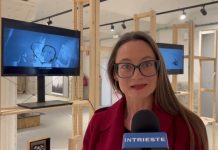
Interviews: Yuliya Coretti, Kateryna Yakymenko of Onda Giovani di Rodnik, Ksenija Kryvoruchko – President of Rodnik
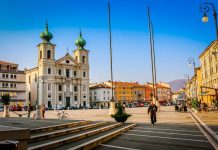
In a city long shaped by shifting borders and layered identities, a new cultural initiative is offering a restrained but pointed message: coexistence is still possible, even amid war.
On Tuesday morning, at the Civic Museum of Oriental Art, the Ukrainian-Russian cultural association Rodnik presented its Calendar of Peace 2026, a project that brings together young people of Ukrainian and Russian backgrounds in traditional dress, photographed side by side. The calendar, now in its latest edition, was conceived as a symbolic gesture of dialogue at a time when relations between the two nations remain defined by conflict.
The presentation was attended by Trieste’s mayor, Roberto Dipiazza, and the city’s councillor for culture and tourism, Giorgio Rossi, alongside representatives of Rodnik, including its president, Ksenija Kryvoruchko. Founded in Trieste in 2009, the association brings together Ukrainians, Russians, Serbs and Italians, many of whom have lived for years as part of the city’s multicultural fabric.
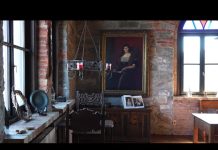
The calendar was developed by Rodnik’s youth group, Onda Giovani, and realized through a collaborative effort carried out largely in participants’ free time. The photographic sessions were led by Yuliya Coretti, a photographer and graphic designer, with assistance from Filipp Fedorov. The settings were deliberately rooted in the region: the Casa Carsica museum in Rupingrande, the Milic trattoria in Sagrado, and the Monte d’Oro equestrian center, also known as Dolga Krona.
Each month of the calendar features young men and women wearing traditional Ukrainian and Russian costumes together. The images are accompanied by quotations from Ukrainian, Russian and Italian cultural figures, as well as short reflections and advice contributed by Kateryna Yakymenko, an energy therapist and member of the association.
Speaking at the event, Mayor Dipiazza referred to the ongoing war between Russia and Ukraine, expressing hope for an end to the conflict. He also recalled Trieste’s own recent history, pointing to the city’s role in reconciliation among Italy, Slovenia and Croatia after decades of political tension. The reference was a reminder that Trieste, once a fault line between worlds, has often served as a meeting point rather than a dividing one.
Mr. Rossi, the councillor for culture and tourism, emphasized the challenges faced by migrant communities in preserving their cultural heritage. “Emigrating from one’s country is not easy,” he said. “Living one’s traditions and values is no longer automatic, especially for younger generations, who risk losing touch with their roots.” He described the calendar as a meaningful example of cultural continuity, adding that “you cannot look to the future without knowing the past.”
He also acknowledged the particular difficulties faced by Ukrainians since the outbreak of the war. Trieste, he said, has historically shown itself to be a welcoming city, one that offers newcomers the possibility of building a new future without erasing their identities.
Rodnik’s work has extended beyond cultural initiatives. In recent years, the association has focused increasingly on providing assistance to refugees who have arrived in Trieste as a result of the conflict, including both Ukrainians and Russians. According to its members, the organization’s guiding principle has remained unchanged: nationality should not determine solidarity.
Proceeds from the distribution of the calendar will be used to support families assisted by the association, with particular attention to children. For Rodnik, the calendar is not only a fundraising tool but also a public statement—one that challenges the assumption that personal relationships must mirror geopolitical divisions.
The message is deliberately modest. The calendar does not comment directly on politics or military developments. Instead, it proposes a different scale of engagement: shared cultural practices, personal bonds and the visibility of friendship where hostility might be expected.
Acknowledging the skepticism such an initiative may provoke, Rodnik’s representatives said they are aware that the idea of Ukrainians and Russians maintaining close ties during an active conflict can be difficult to accept. Yet, they argue, this difficulty is precisely what makes the project necessary.
Their stated hope is that the new year will bring peace not only to Ukraine but to all regions affected by war, and that no population will continue to bear the costs of prolonged violence. In a city accustomed to navigating the complexities of history, the Calendar of Peace 2026 offers a quiet, visual reminder that reconciliation often begins far from the negotiating table, in shared spaces and everyday gestures.