






















by InTrieste
In the seaside town of Muggia, just south of Trieste, a new experiment in civic participation is taking shape — one that local officials hope will redefine how communities think about safety.
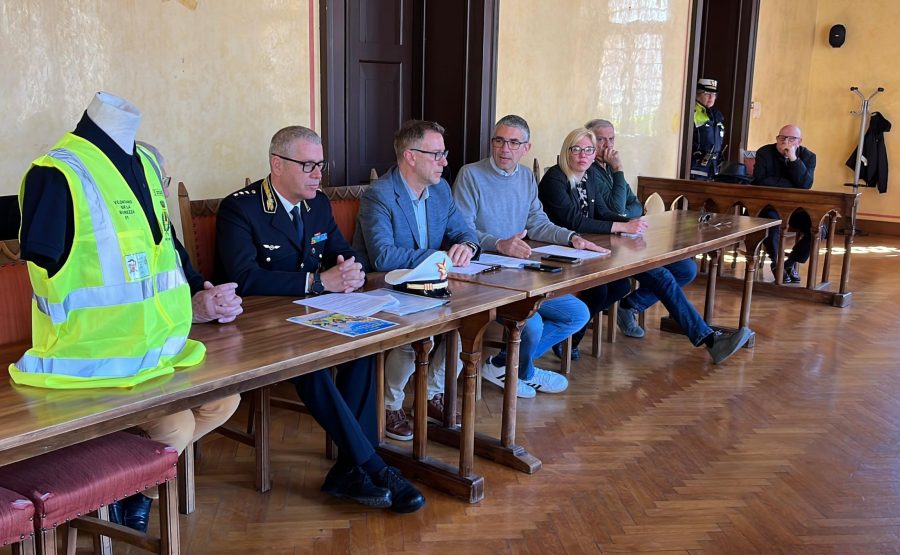
On a mild spring morning, the town’s mayor, Paolo Polidori, stood alongside the regional councillor for security, Pierpaolo Roberti, to unveil a municipal regulation that formally introduces trained citizen volunteers into the fabric of local security efforts. Nearby was Roberto Dellosto, head of the local police, whose officers will coordinate the initiative.
The program — the first of its kind in the former province of Trieste — creates structured groups of residents who, after undergoing specific training, will assist authorities by observing and reporting on conditions in their neighborhoods. They will not intervene directly, officials stressed, nor replace law enforcement. Instead, they are meant to act as an additional set of eyes and ears, identifying potential issues before they escalate.
For Mr. Roberti, the initiative reflects a broader philosophy. “Active participation by citizens,” he said, “represents an added value in ensuring better services.” In his view, security is not solely the domain of institutions but a shared civic responsibility — one that, when embraced collectively, can strengthen both safety and public trust.
The volunteers will be visible. Clad in brightly colored vests bearing the municipality’s logo and a unique identification number, they are intended to signal presence as much as vigilance. Their role is as symbolic as it is practical: a reminder, officials say, that institutions remain attentive, and that residents themselves are invested in the well-being of their town.
Mr. Polidori described the initiative as a response to a growing desire among citizens to play a more active role in community life. By creating a direct link between volunteers and the local police, he argued, the program could serve as both a deterrent to minor offenses and a way to improve residents’ perception of safety — a factor often as significant as crime rates themselves.
That distinction — between being safe and feeling safe — lies at the heart of the project. In smaller towns like Muggia, where social ties are strong but concerns about urban decay and petty crime have grown in recent years, officials see “participatory security” as a way to bridge the gap.
Yet the initiative also enters a broader, and sometimes contentious, debate. Mr. Roberti acknowledged that security policies in Italy are often shaped by ideological divisions, with differing views on the balance between enforcement and community engagement. Programs like this one, he suggested, offer a path beyond those divides.
“Security,” he said, “is a primary interest for citizens, regardless of political orientation.”
For now, Muggia stands as a test case. Regional authorities have expressed hope that other municipalities — across political lines — will follow suit, adopting similar models of volunteer engagement.
Whether the experiment will deliver measurable results remains to be seen. But in this corner of northeastern Italy, the effort is already reshaping the conversation, placing ordinary citizens at the center of a question long left to institutions alone: how to build a safer community.