















by MK
In a city better known for its windswept piazzas, a quieter transformation is unfolding behind hospital doors. At Maggiore Hospital, dentistry is being reimagined—not as a privilege, but as a public service. The shift is subtle but consequential: care that was once out of reach for many is becoming increasingly accessible, regardless of income.
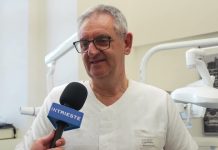
Leading the effort is professor Roberto Di Lenarda, a clinician and academic who has spent nearly a decade building one of Italy’s most ambitious public dentistry programs. His aim is straightforward but far-reaching: to ensure that no patient is excluded from treatment because of cost.
“Our mission goes beyond education,” he said in an interview at the hospital. “It’s about redefining access.”
That commitment begins with a broader understanding of health. For Dr. Di Lenarda and his team, oral care is not separate from the rest of the body. Patients undergoing treatment for heart disease, cancer, or blood disorders often require timely dental interventions—services that, in many systems, are delayed or unaffordable.
Here, those barriers are deliberately reduced. The department works in close coordination with cardiologists, oncologists, pulmonologists, and other specialists, providing rapid and integrated care for patients whose conditions demand it. The goal is not only efficiency, but equity: ensuring that even the most medically complex cases are treated without delay.
Access, however, is shaped as much by economics as by organization. In Italy, advanced dental procedures—implants, prosthetics, oral surgery—are frequently paid out of pocket, placing them beyond the reach of many families. At Maggiore Hospital, a different model is in place. Costs are calibrated to patients’ financial situations, allowing even high-level treatments to become attainable.
“Dental procedures can be prohibitively expensive,” Dr. Di Lenarda acknowledged. “So we created a system where patients contribute based on what they can afford. This makes a real difference in who can receive care.”
The impact is visible in the diversity of patients passing through the clinic: elderly residents on fixed incomes, young families, and individuals recovering from serious illnesses. For some, it is the first time they have been able to consider treatments long postponed.
The program’s reach extends further through its partnership with the University of Trieste, where students train directly within the hospital. Under close supervision, they move from theory to practice, contributing to patient care while gaining hands-on experience. The arrangement not only strengthens education but expands capacity, enabling the clinic to serve more people.
“We prepare our students to be competent and responsible,” Dr. Di Lenarda said. “But also to understand the importance of access—to recognize that care must be available to everyone.”
Beyond routine dentistry, the hospital provides specialized prosthetics for patients recovering from cancer surgeries or traumatic injuries, often in collaboration with external technicians. These interventions, while complex, are made available within the same framework of accessibility—another step toward reducing disparities in care.
The philosophy is reflected even in small details. A colorful mural created by local autistic children brightens one of the department’s walls, a reminder that inclusion is not an abstract principle but a daily practice.
“In Italy, our model is still pioneering,” Dr. Di Lenarda said. “We offer immediate care, including emergencies, and we do not turn people away because of financial constraints.”
The scope of services is comprehensive—oral medicine, orthodontics, advanced surgery—supported by ongoing research and innovation. Yet the defining feature of the program remains its openness: a system designed not around exclusivity, but around need.
In an era when public healthcare systems face increasing pressure, the work at Maggiore Hospital suggests a different approach—one in which accessibility is not an afterthought, but the foundation. Here, the revolution is quiet, unfolding patient by patient, but its implications are broad: a reminder that dental care, long treated as optional, can instead be made available to all.